
AI Search Optimization for Graduate Education Marketing in 2026
December 17th, 2025 by
What 2025 Research Tells Us About AI Visibility, Zero-Click Search, and Enrollment Strategy
Executive Summary
Here’s the reality: the way prospective graduate students find and evaluate programs has changed faster than most of us anticipated. Research from across 2025 — including original survey data from UPCEA and Search Influence (n=705) — shows that half of all prospects now use AI tools weekly, while 82% are more likely to consider programs appearing on page one of search results. Zero-click searches have climbed to 69% of all Google queries. AI Overviews now appear on nearly half of search results.
And this is just where we are today. The trajectory for 2026 is clear.
Key Findings at a Glance
| Metric | 2025 Finding | Implication for 2026 | Source |
|---|---|---|---|
| AI tool usage (weekly+) | 50% of prospects | Expect 60%+ as tools improve | UPCEA/Search Influence |
| Page one consideration | 82% more likely | AI citations become equally critical | UPCEA/Search Influence |
| Zero-click searches | 69% of queries | Will exceed 75% for informational | Similarweb/SparkToro |
| AI Overview reach | 1.5B monthly users | Expanding to 80%+ of queries | Google Q1 2025 |
| ChatGPT weekly users | 800 million | Continued exponential growth | OpenAI September 2025 |
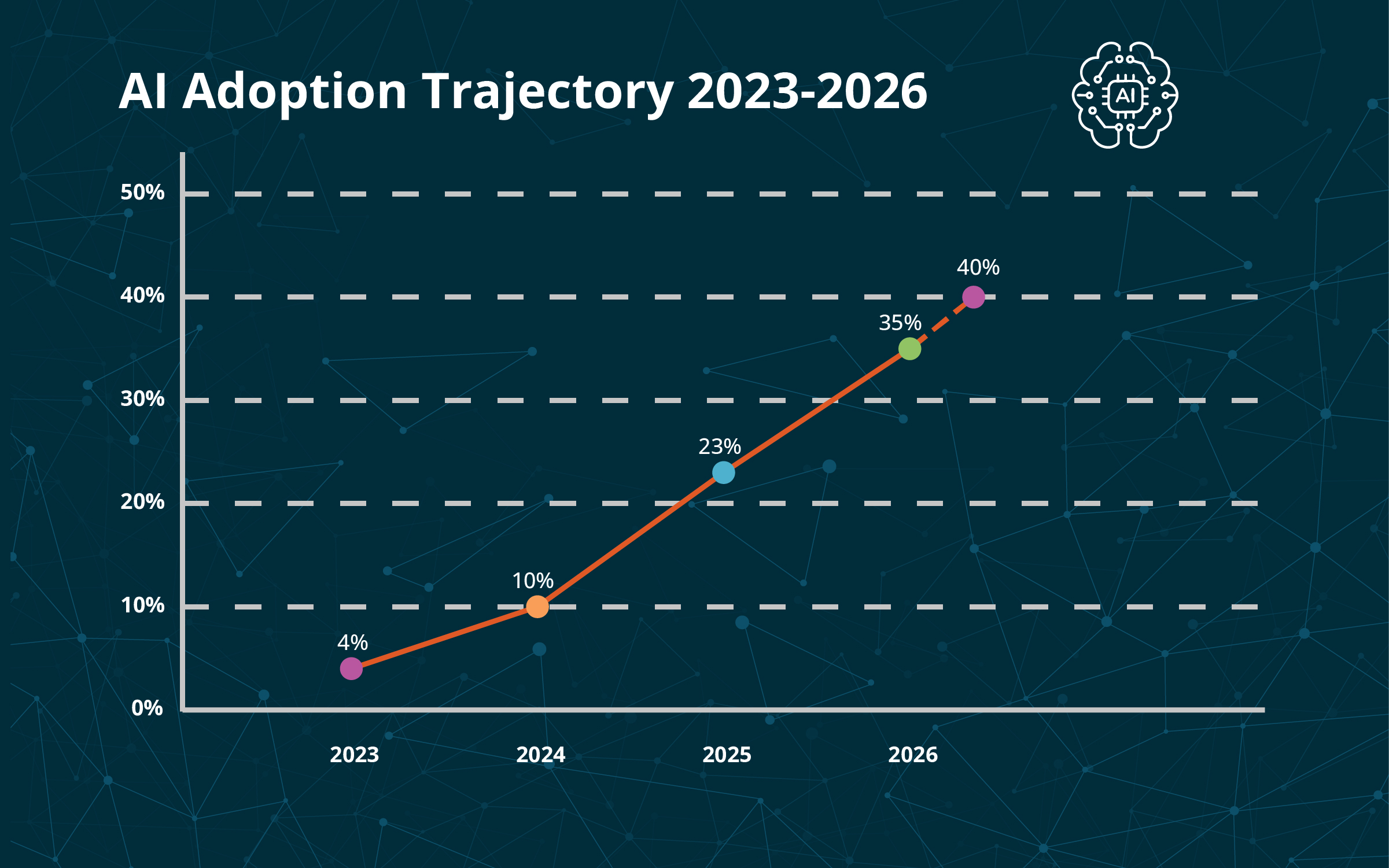
| AI in college search | 23% (6x from 2023) | 35-40% projected | Carnegie 2025 |
So what does this mean for 2026? Traditional higher education SEO and paid search remain foundational—that hasn’t changed. But they’re no longer sufficient on their own. Institutions that fail to invest in AI search optimization and AI visibility strategy risk disappearing from the consideration set entirely, before prospects ever visit a website.
The institutions that act now on GEO for higher education will have a 12-month head start on those still debating whether this matters.
The State of AI Search: Where We Are and Where We’re Headed
The Adoption Curve Has Been Steeper Than Anyone Expected
I’ll be honest: when we started tracking AI adoption in college search two years ago, I didn’t expect to see numbers like these so quickly.
According to Carnegie’s 2025 Summer Research Series, AI usage in the college search process jumped from 4% in 2023 to 10% in 2024 to 23% in 2025—nearly 6x in two years. Rising students show even higher adoption at 25%, while parents trail slightly at 21%.
If this trajectory holds—and there’s no indication it won’t—we’re looking at 35-40% AI usage in college search by the end of 2026. For graduate and professional programs, where prospects skew older and more research-oriented, adoption may be even higher.
The UPCEA/Search Influence study of 705 qualified respondents (March 2025) digs deeper into professional and continuing education prospects specifically:
- 24% use AI-powered tools daily
- 26% use them weekly
- 18% use them a few times per month
- 17% never use AI tools for search
Younger prospects show higher daily and weekly usage, which isn’t surprising. But here’s what caught my attention: even among older demographics, the “never use” category is a minority. This isn’t a Gen Z phenomenon anymore. By 2026, the “never use” segment will likely shrink to single digits.
Search Engines Still Dominate—But the Picture Is Getting More Complicated
When researching professional and continuing education programs, prospects use multiple platforms, often in the same search session:
Platform Usage for PCE Program Research (UPCEA/Search Influence 2025)
| Platform | Extremely/Very Likely to Use |
|---|---|
| Traditional search engines | 84% |
| University/college websites | 63% |
| AI chatbots (ChatGPT, Gemini) | 36% |
| AI search engines | 35% |
| Social media platforms | 34% |
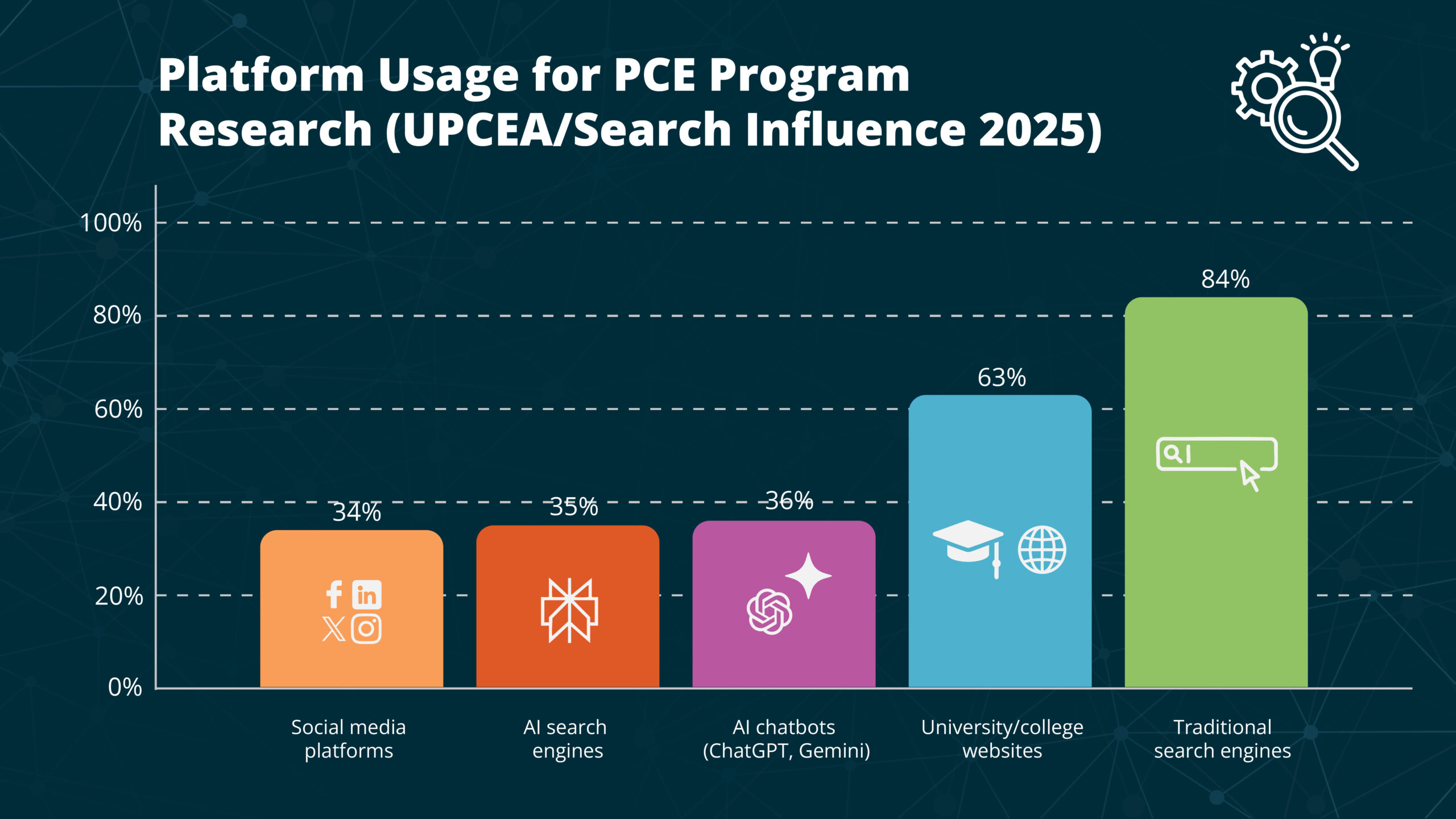
Here’s the number that should get your attention: AI-assisted tools now warrant the same strategic investment as social media, where institutions spend an average of $166,303 annually on advertising, according to UPCEA’s 2024 Marketing Survey. Are you spending proportionally on AI visibility for your university? Most graduate enrollment marketing teams aren’t—yet. By 2026, that gap will separate the visible from the invisible.
The Lines Between “Search” and “Browse” Have Blurred Permanently
We asked respondents which platforms they use “in a way similar to how you would use a traditional search engine.” The results tell us something important about how prospects actually behave:
- YouTube: 61%
- AI-powered search tools: 50%
- Amazon: 32%
- Instagram: 28%
- Reddit: 28%

Prospects don’t distinguish between “search” and “browsing” the way we do in marketing meetings. YouTube is a search engine to them. ChatGPT is a search engine. Instagram is a search engine. Your content has to work across all of them, or you’re only reaching part of your audience.
For 2026 planning, this means content strategy can’t be siloed by platform. The same information needs to exist in formats optimized for each discovery channel.
The Zero-Click Search Reality: Planning for a Post-Click World
Most Searches Don’t Result in Clicks Anymore
Zero-click searches—queries where users get answers directly from search results without visiting a website—have reached a tipping point:
- 69% of Google searches ended without a click (May 2025), up from 56% in May 2024
- 60-63% of all Google searches result in zero clicks according to SparkToro/Similarweb
- 70-90% click-through rate decline when AI Overviews appear

Google’s AI Overviews now reach 1.5 billion monthly users as of Q1 2025. The feature appears on 47% of searches today, with Google’s internal testing suggesting this will exceed 80% for informational queries in the near future.
For 2026 planning: Assume zero-click will exceed 75% for the informational queries that drive graduate program research. Questions like “What are the admission requirements for [Program X]?” or “How much does an MBA cost?”—exactly the queries your prospects are typing—will increasingly be answered without a click.
What Zero-Click Search Means for 2026 Graduate Enrollment Marketing
The implications for university marketing teams are significant, and I don’t think we should sugarcoat them:
- Traditional funnel metrics are becoming less reliable.
If prospects get answers about tuition, deadlines, and program details from AI summaries, they may form opinions about your institution without ever reaching your website. Your analytics won’t capture that interaction. You’ll have incomplete data on what’s actually influencing enrollment decisions.
2026 action: Build brand visibility metrics alongside click metrics. Track AI citations, brand mentions, and sentiment—not just traffic. This requires a different approach to higher education analytics.
- You’re paying more for declining performance.
Everspring reports that the average cost-per-click for higher education terms has increased 45% year-over-year, while performance has declined. That’s a rough combination that will only intensify.
2026 action: Rebalance paid media budgets. The ROI calculus on traditional higher education PPC is shifting. Organic AI visibility may deliver better long-term value.
- This is already disrupting adjacent industries.
Learning platform Chegg reported a 49% decline in non-subscriber traffic between January 2024 and January 2025, coinciding with AI Overviews answering homework and study questions that previously drove site visits. Graduate enrollment marketing isn’t immune to the same dynamics.
2026 action: Don’t wait for disruption to hit your specific program category. Invest in zero-click search strategy now.

The Trust Signal Hidden in AI Overviews
Here’s where the data gets interesting. The UPCEA/Search Influence study shows how prospects actually interact with AI Overviews:
- 79% read the AI-generated overview when it appears
- 51% click on sources most of the time or always
- 43% click occasionally
- 56% are more likely to trust brands/websites cited in AI Overviews
That last number matters enormously for 2026 strategy. Being cited in AI Overviews isn’t just about visibility—it’s a credibility signal. When prospects see your institution referenced in AI-generated content, they’re more likely to view you as trustworthy. Absence from those results may communicate the opposite.
Rethinking Optimization: From Higher Education SEO to GEO
SEO vs. GEO for Universities: A Different Kind of Target
Here’s a useful way to think about the shift we’re navigating:
Traditional SEO feels like optimizing for an algorithm—a system that scores and ranks based on signals (keywords, links, technical factors). It’s mechanical, pattern-matching. You’re essentially optimizing for a librarian: cataloging, indexing, and retrieval.
GEO (Generative Engine Optimization) feels fundamentally different. It feels like optimizing for a reader who happens to have perfect memory and infinite patience—an entity that’s actually trying to understand what you do, synthesize it, and explain it to someone else. You’re optimizing for a research assistant: understanding, synthesizing, recommending.
Put more directly: with GEO, you’re writing content that helps an AI form an accurate opinion about your institution—because that’s what it’s going to share with prospects.
The practical difference:
- SEO rewards structure and signals
- GEO rewards clarity, accuracy, and citable claims
You’re not just trying to rank anymore. You’re trying to be the source an AI would quote if it were writing an article about your program category.
What This Means for University Content Strategy in 2026
For 2026, your higher education content strategy needs to serve two masters simultaneously:
- Traditional search engines that still drive significant traffic and still reward keyword optimization, technical SEO, and backlink profiles
- AI systems that are reading your content to form an understanding of who you are, what you offer, and whether you’re worth recommending
The good news: these aren’t entirely at odds. Clear, factual, well-structured content performs well for both. But the emphasis shifts. AI systems don’t care about keyword density—they care about whether they can extract accurate, citable information. This is the core of AI-ready website optimization for higher education.
What Prospects Trust—and Don’t Trust
The Trust Hierarchy Is Clear (and Stable)
When searching for professional and continuing education programs, prospect trust varies dramatically by source:
Trust Levels by Platform (UPCEA/Search Influence 2025)
| Source | Extremely/Very Trustworthy |
|---|---|
| University/college websites | 77% |
| Traditional search engines | 66% |
| AI chatbots | 33% |
| Social media platforms | 20% |
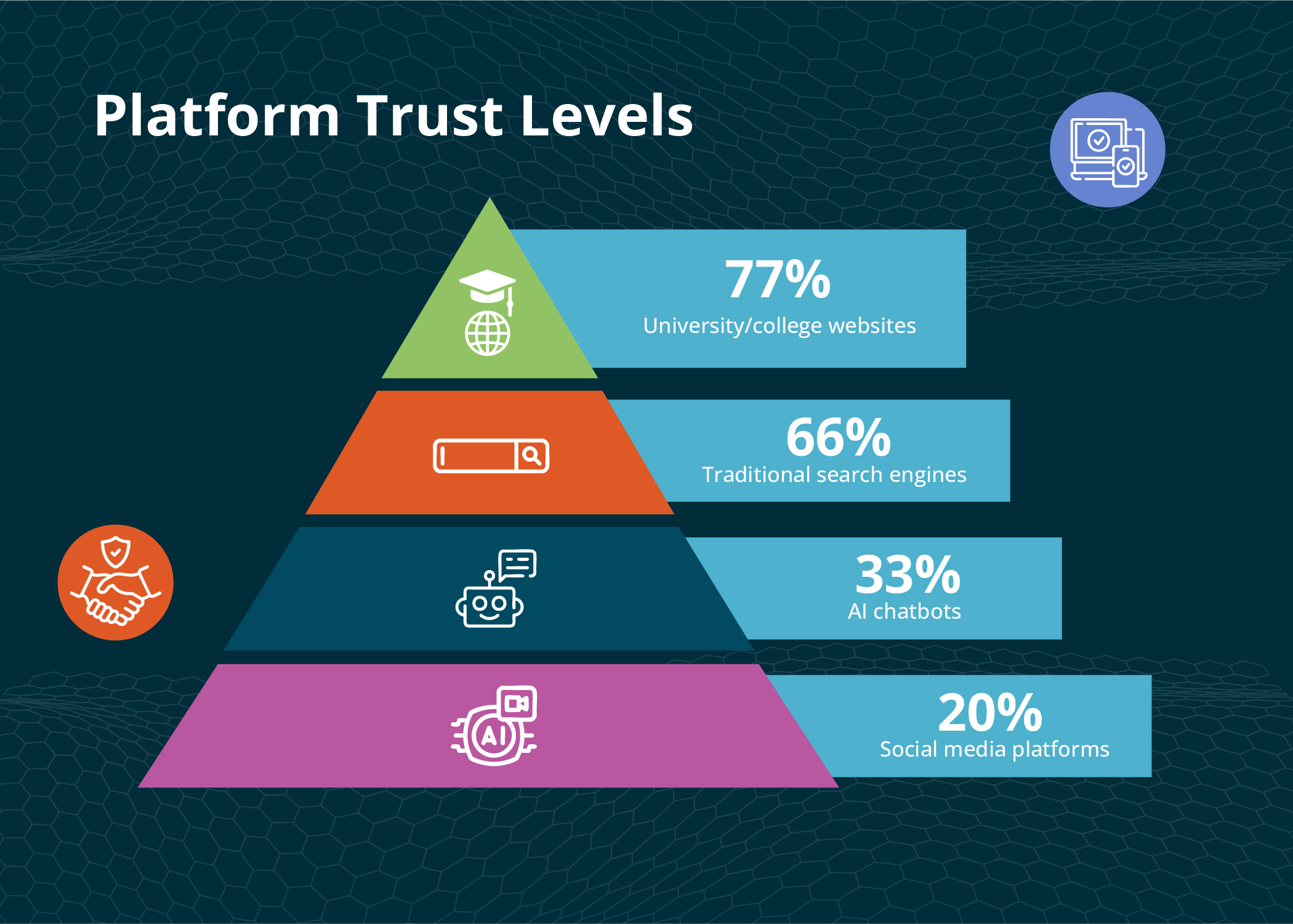
University websites are still the most trusted source by a wide margin. That’s actually good news for 2026. While AI tools are gaining usage, the destination of trust remains institutional websites. The challenge is making sure AI tools surface and cite your content accurately—so prospects who trust AI still end up trusting you.
Think of it this way: AI is becoming the intermediary, but your website is still the authority. You need AI to accurately represent what’s on your site.
Not Everyone Is Worried About AI Accuracy
This surprised me a bit: nearly a third (32%) of respondents have no concerns whatsoever about using AI search tools for researching professional and continuing education programs.
Among those who do have concerns:
- 28% worry about validity, reliability, or accuracy
- 7% cite privacy or security concerns
- The remainder mention environmental impact, bias, and relevance
So while accuracy concerns exist, a substantial portion of your prospect pool is comfortable taking AI recommendations at face value. That makes your AI presence even more critical—if AI gets your information wrong, a third of prospects won’t question it.
What Would Build More Trust?
When asked what features would be most valuable in AI-generated search results:
- Transparent sources for AI-generated recommendations: 51%
- AI-generated side-by-side comparisons of programs: 50%
- Emphasis on accredited institutions: 39%
- AI personalization based on interests: (favored by younger prospects)
Prospects want AI to show its work. Transparent sourcing and comparison tools matter more than fancy personalization for most age groups.
2026 implication: Structure your content with clear, citable claims. Include specific data points, credentials, and outcomes that AI can reference. Make it easy for AI to cite you accurately.
Search Query Patterns: How Behavior Differs by Platform
People Talk to AI Differently Than They Talk to Google
This is one of the more actionable findings from the research. The UPCEA/Search Influence study asked respondents what they would type when searching for an MBA program across different platforms. The patterns are distinct:
Query Type by Platform
| Query Type | Traditional Search | AI Search Engine | AI Chatbot | Social Media |
|---|---|---|---|---|
| Phrase | 80% | 64% | 55% | 71% |
| Question | 12% | 16% | 23% | 8% |
| Command | 1% | 8% | 9% | 2% |
| One-word | 6% | 6% | 7% | 9% |
| Wouldn’t use | 1% | 5% | 6% | 10% |

On traditional search, 80% of prospects type phrases like “MBA programs near me.” On AI chatbots, that drops to 55%, while questions jump to 23% and commands to 9%.
What this means for 2026 content: If you’re only optimizing for keyword phrases, you’re missing the conversational queries that dominate AI interactions. Content that answers questions directly—”What is the best MBA program for working professionals?” “Compare online vs. in-person MBA programs”—will perform better in AI contexts.
The Core Keywords Still Matter
Across all platforms, the most common search approaches for MBA programs included:
- “MBA programs/degrees/courses/education” (27-31%)
- “Best MBA programs/schools” (8-11%)
- “MBA programs near me” (8-12%)
The consistency across platforms tells us that core keyword targeting still matters. People are looking for the same information—they’re just asking for it differently depending on where they’re searching. Your content needs to address both the keyword and the question.
Platform-Specific Behaviors: What to Prioritize for 2026
ChatGPT Is the Default, But Don’t Ignore the Others
Among prospects likely to use AI platforms for program research:
| AI Platform | Would Use |
|---|---|
| ChatGPT | 78% |
| Gemini | 56% |
| Perplexity | 20% |
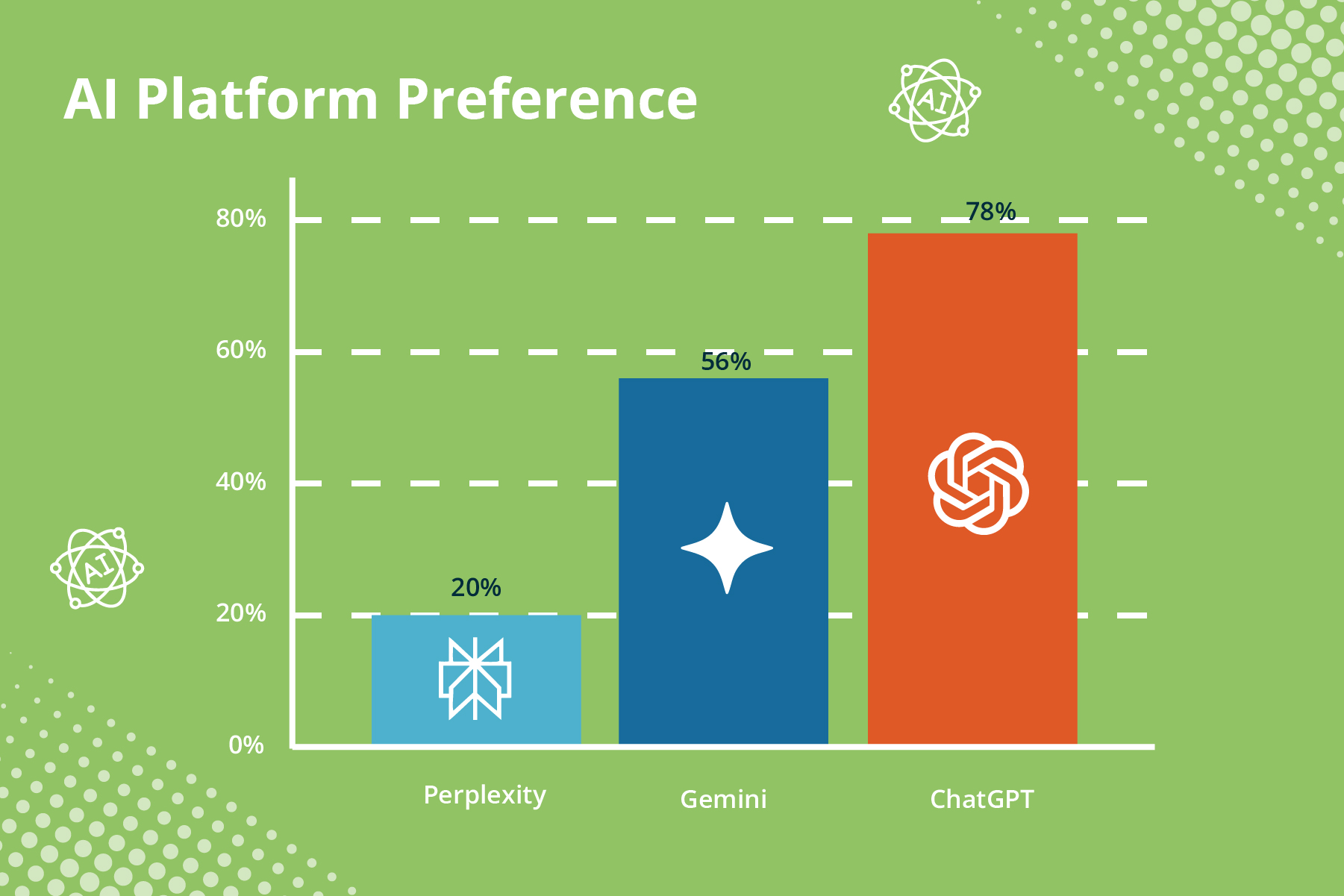
Here’s an interesting wrinkle: older age groups were more likely to use Gemini and Perplexity than younger prospects. My guess is this reflects different adoption pathways—Gemini through the Google ecosystem that older users are more embedded in, Perplexity through professional and research applications.
2026 consideration: Your AI visibility strategy can’t focus on ChatGPT alone. Gemini is integrated into Google’s ecosystem (where 84% of your prospects still search), and Perplexity is growing fast among research-oriented users—exactly your graduate prospect demographic.
The Scale of ChatGPT Is Hard to Overstate
As of late 2025, ChatGPT’s numbers are staggering:
- 800 million weekly active users (September 2025)
- 190 million daily active users
- 5.72 billion monthly visits
- 77.2 million monthly active users in the US alone
- 46.7% of users are aged 18-24
For context, Perplexity AI processes 780 million monthly queries with 22 million monthly active users—substantial and growing fast, but still an order of magnitude smaller than ChatGPT.

Social Media Platform Preferences Vary by Age
Among prospects likely to use social media for program research:
| Platform | Would Use |
|---|---|
| YouTube | 57% |
| 49% | |
| 43% | |
| 35% | |
| 31% |
The age patterns are predictable:
- YouTube, Instagram, TikTok: Skew younger
- LinkedIn, Facebook: Skew older
- Reddit: Relatively consistent across age groups

What Actually Works on Social
When using social media to research programs, prospects find these content types most helpful:
- Program summaries or descriptions: 65%
- Career advice related to education choices: 54%
- Student testimonials: 50%
One exception worth noting: for 18-22-year-olds, university/college advertisements ranked as the most helpful content type. Traditional advertising still resonates with the youngest prospects in ways it doesn’t with older demographics.
The AI Tools Landscape: A Quick Reference
Major AI Platforms by the Numbers (Late 2025)
| Platform | Monthly Active Users | Monthly Queries | Key Demographics |
|---|---|---|---|
| ChatGPT | 800M weekly / 190M daily | 5.72B visits | 46.7% aged 18-24 |
| Google Gemini | 284M monthly visits | — | 18% education sector |
| Perplexity AI | 22M MAU | 780M queries | 57% aged 18-34 |
| Claude | ~3.2% US market share | — | Professional/technical skew |
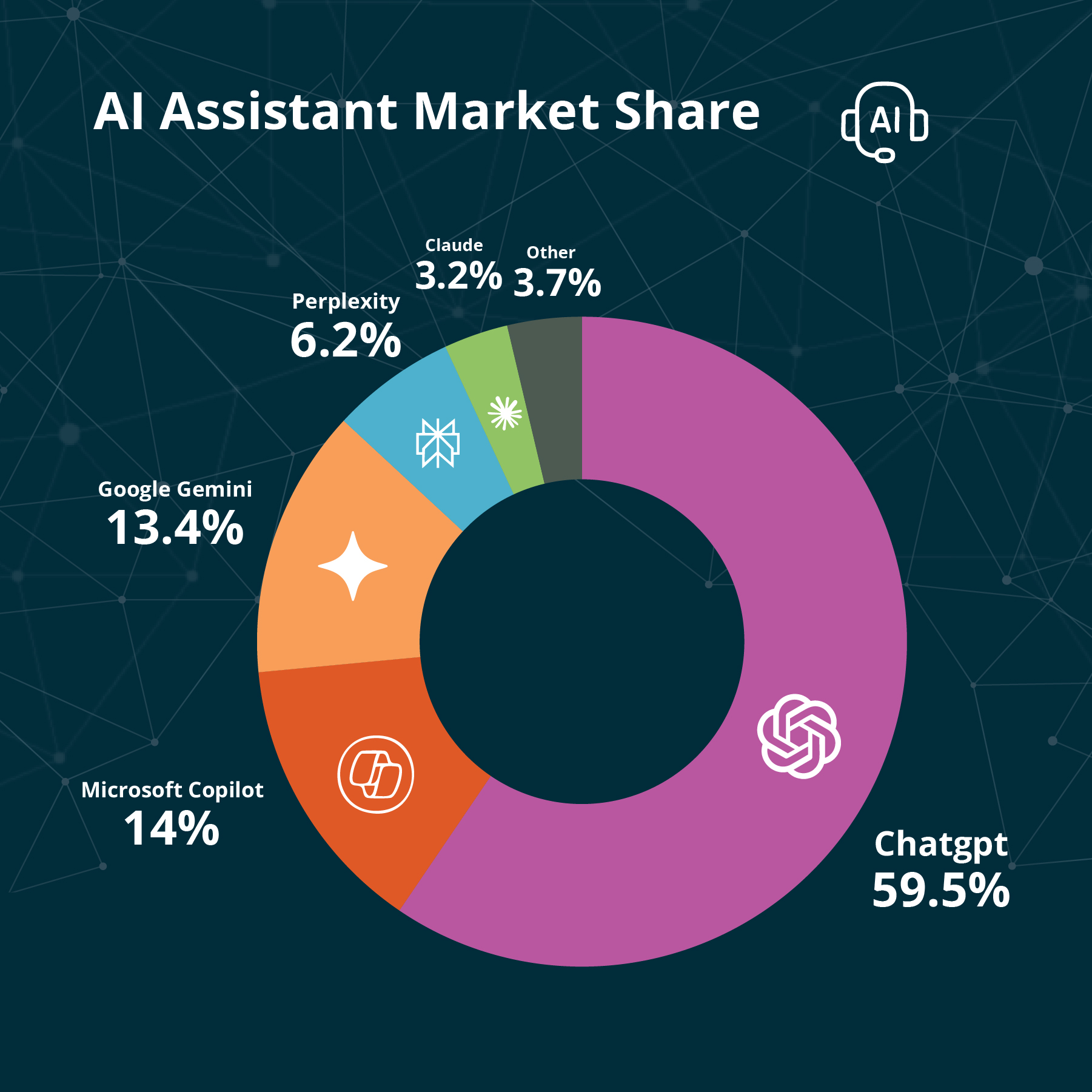
US Market Share Context
- ChatGPT: 59.5%
- Microsoft Copilot: 14%
- Google Gemini: 13.4%
- Perplexity: 6.2%
- Claude: 3.2%
Strategic Roadmap: AI Search Optimization for Higher Education in 2026
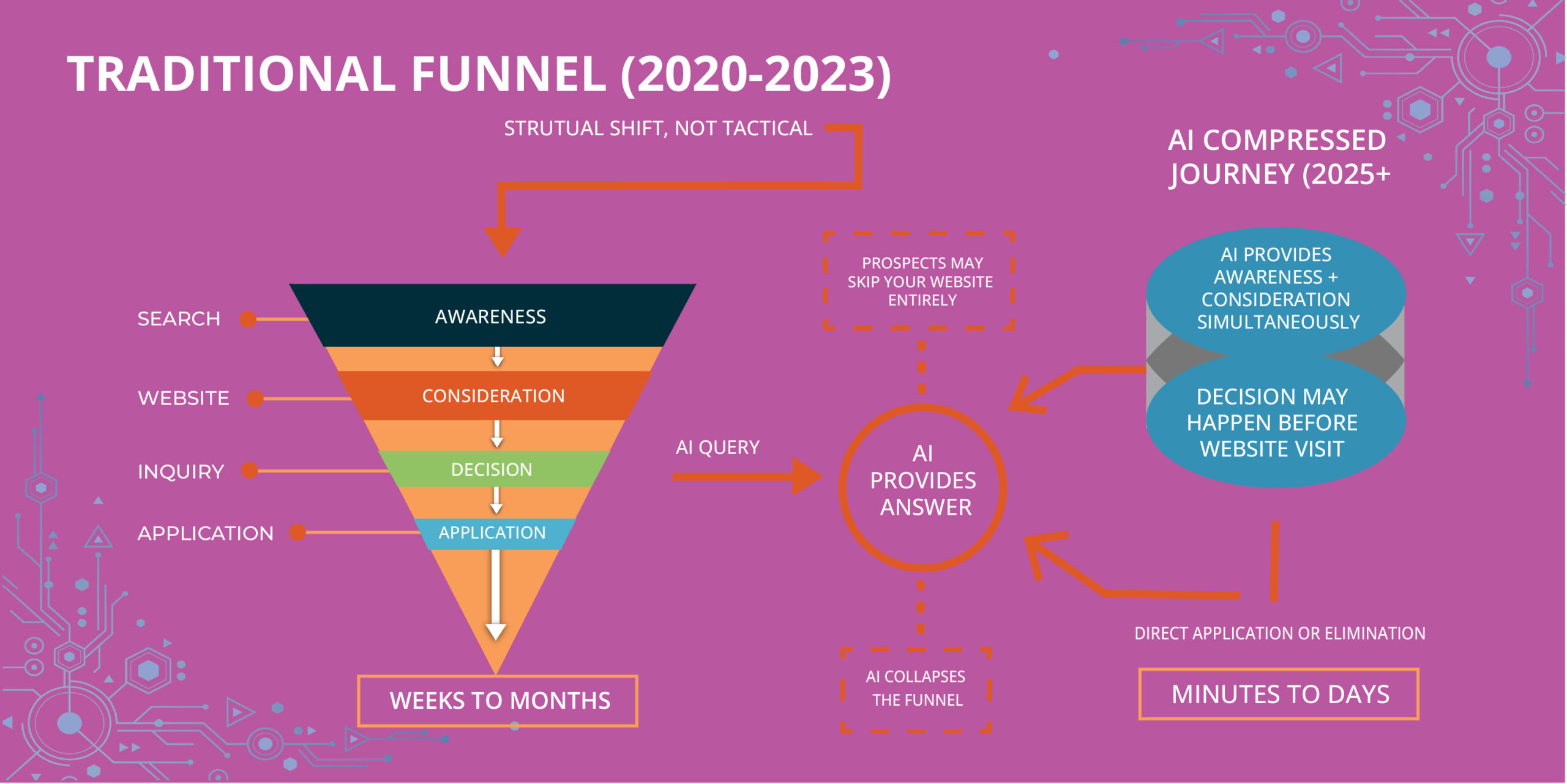
The Shift Is Structural, Not Tactical
Let me be direct about what the data is telling us about graduate enrollment marketing:
- Search behavior has diversified permanently.
Prospects use 5+ platforms interchangeably for program research. If you’re only optimizing for Google, you’re reaching a shrinking portion of your audience. Single-platform strategies are increasingly risky.
- AI is compressing your funnel.
Generative AI tools deliver answers about your institution—and your competitors—before prospects visit any website. The traditional “awareness → consideration → decision” funnel is collapsing. Prospects may move from “never heard of you” to “crossed you off the list” without a single website visit.
- Citation is the new ranking.
Being referenced in AI Overviews and AI tool responses builds credibility. Absence from these results may signal irrelevance. For a generation that trusts AI to give them straight answers, not appearing in those answers is a problem.
- Your metrics are incomplete.
Website traffic and click-through rates don’t capture AI-mediated discovery. Brand visibility and AI citation frequency matter, but most institutions aren’t tracking them yet.
Your 2026 Action Plan for Graduate Enrollment Marketing
Q1 2026: Foundation—AI Visibility Audit and Technical SEO
- Conduct an AI visibility audit. Query ChatGPT, Perplexity, and Google AI Overviews with the exact phrases your prospects use. Screenshot what appears. Document what’s missing or inaccurate. This is your baseline for AI search optimization.
- Review your website’s structure for AI readiness. AI tools favor content with clear headings, factual statements, and authoritative data that they can easily extract and cite. Does your program content deliver that, or is it buried in marketing language? An AI-ready website audit should be your first step.
- Check your technical SEO fundamentals. Crawlability and site speed matter more than ever for higher education SEO. AI engines are less patient than traditional crawlers. If they can’t see your content, they can’t cite it.
Q2 2026: Content Development—GEO and Multi-Platform Strategy
- Develop a YouTube strategy if you don’t have one. 61% of prospects use YouTube like a search engine. Program overviews, student testimonials, and career outcome videos aren’t optional anymore for graduate enrollment marketing.
- Create content in multiple formats for AI optimization. AI chatbots favor Q&A formats. Traditional search favors keyword phrases. Social favors summaries and testimonials. The same information needs to exist in multiple expressions optimized for each platform.
- Build FAQ and comparison content. These formats are highly citable by AI systems and directly address how prospects query AI tools. This is core GEO for universities.

Q3-Q4 2026: Infrastructure and Measurement Evolution
- Implement structured data and schema markup. Help AI tools understand your programs, faculty, outcomes, and accreditations through proper technical implementation. This is table stakes for AI visibility in higher education.
- Distribute content through authoritative channels. AI tools favor citations from recognized sources. Publishing through professional associations, research outlets, and established media increases the likelihood of AI citation—a key component of any higher education SEO strategy.
- Evolve your measurement approach. Start tracking brand mentions, AI citations, and sentiment alongside traditional metrics. The full picture of enrollment marketing visibility now extends well beyond clickable results.
Methodology
UPCEA/Search Influence Study (2025)
Survey period: March 11-13, 2025
Sample:
- Total participants: 1,061 individuals
- Qualified respondents: 760 (met all criteria)
- Completed surveys: 705
Qualification criteria:
- Adults aged 18-60
- Minimum high school diploma
- Not currently enrolled in a PCE program
- Interested in advancing skills through professional/continuing education
Respondent demographics:
- 55% female, 45% male
- 68% employed full-time
- Education: 32% bachelor’s degree, 19% some college, 18% master’s degree
- Age: 25% ages 46-54, 19% ages 55-60, 17% ages 35-40
Distribution: Internet panel
Conducted by: UPCEA and Search Influence
Carnegie Summer Research Series (2025)
Sample: 3,400+ prospective students and parents
Focus: College choice trends, AI usage in admissions, personality-driven communication
Key longitudinal finding: AI usage in college search: 4% (2023) → 10% (2024) → 23% (2025)
Additional Data Sources
Platform statistics compiled from company announcements, third-party tracking services (Similarweb, SparkToro, Semrush), and industry research reports. All figures represent the most recent publicly available data as of November 2025.
Glossary of Key Terms
AI Overview: Google Search feature providing an AI-generated summary at the top of results, synthesizing information from multiple sources. Previously called Search Generative Experience (SGE).
Zero-click search: A query where users find their answer directly in search results (featured snippets, AI Overviews, knowledge panels) without clicking to any website.
Generative Engine Optimization (GEO): Optimizing content and digital presence to appear in AI-generated responses from tools like ChatGPT, Perplexity, and Google’s AI Overviews. Unlike traditional SEO (optimizing for algorithms), GEO focuses on helping AI systems accurately understand and represent your institution.
Professional and Continuing Education (PCE): Post-secondary programs for working adults seeking to advance skills, change careers, or earn credentials—including graduate degrees, certificates, professional development, and continuing education.
AI chatbot: Conversational AI interface (ChatGPT, Gemini) responding to queries in natural language, often synthesizing information from training data and/or real-time web search.
AI search engine: Search tool (Perplexity, SearchGPT) providing direct answers by searching the web and synthesizing results, rather than returning a list of links.
Frequently Asked Questions
How are prospective students using AI tools in their program search?
Half of prospects (50%) use AI-powered tools at least weekly for general information search. For program research specifically, 36% are extremely or very likely to use AI chatbots, and 35% likely to use AI search engines. ChatGPT dominates (78% of AI users would use it), followed by Gemini (56%) and Perplexity (20%).
Do prospects trust AI-generated information about educational programs?
It’s complicated. Only 33% rate AI chatbots as extremely or very trustworthy for program research, compared to 77% for university websites. But 32% have no concerns whatsoever about using AI for this purpose, and 56% say they’re more likely to trust brands cited in Google’s AI Overviews. Trust in AI is lower than traditional sources, but AI citations boost trust in the sources cited.
What percentage of searches result in zero clicks?
As of May 2025, roughly 69% of Google searches end without a click to any website, up from 56% a year earlier. When AI Overviews appear, click-through rates to top-ranking websites decline by 70-90%.
Which platforms do prospects use to research graduate programs?
Search engines dominate (84% extremely/very likely), followed by university websites (63%), AI chatbots (36%), AI search engines (35%), and social media (34%). But 61% also use YouTube “like a search engine,” and 50% use AI tools the same way. Platform diversification is the new normal.
How do search queries differ between traditional search and AI tools?
On traditional search, 80% use phrase-based queries. On AI chatbots, only 55% use phrases while 23% ask questions and 9% use commands. AI-optimized content should address conversational queries and direct questions—not just keyword phrases.
What content types work best on social media for program discovery?
Program summaries and descriptions (65%), career advice (54%), and student testimonials (50%) rate highest. Exception: for 18-22 year-olds, university advertisements were actually rated most helpful.
What’s the difference between SEO and GEO?
Traditional SEO optimizes for search algorithms—systems that score and rank based on signals like keywords and links. GEO (Generative Engine Optimization) optimizes for AI understanding—helping AI systems accurately comprehend and represent your institution so they can recommend you to prospects. SEO is like optimizing for a librarian; GEO is like optimizing for a research assistant who needs to explain you to someone else.
About This Report
This analysis synthesizes original research from the UPCEA/Search Influence study with data from Carnegie Higher Education, Everspring, EAB, and platform-specific metrics to provide a forward-looking view of how AI search optimization is reshaping program discovery in graduate education.
The report is designed to help enrollment marketing leaders, higher education SEO professionals, and university marketing teams understand the AI visibility landscape and develop effective GEO strategies for 2026.
Primary research sponsor: Search Influence
Research partner: UPCEA (University Professional and Continuing Education Association)
Report date: November 2025

Sources and Citations
Primary Research
- UPCEA and Search Influence. “AI Search in Higher Education: How Prospects Search in 2025.” Survey conducted March 11-13, 2025. n=705 qualified respondents.
- Carnegie Higher Education. “2025 Summer Research Series: AI Use in the College Search.” Survey of 3,400+ prospective students and parents.
- https://www.carnegiehighered.com/blog/research-series-ai-in-college-search/
- https://www.carnegiehighered.com/wp-content/uploads/2025/08/Carnegie_Summer-Research-Series-AI-Use-College-Search-2025.pdf
Industry Reports
- Everspring. “AI and the Collapse of Student Search: 2025 Higher Ed Trend Report.” May 2025.
- https://www.everspringpartners.com/2025-ai-higher-ed-search-trends
- https://www.everspringpartners.com/ai-has-changed-how-students-search-and-universities-are-paying-the-price
- EAB. “Is Your College Website AI-Ready and Built to Drive Enrollment?” July 2025.
- EAB. “How Graduate Enrollment Leaders—and Prospective Students—Are Using AI.”
- Semrush. “AI Overviews Study: What 2025 SEO Data Tells Us About Google’s Search Shift.” May 2025.
- SparkToro and Similarweb. Zero-click search analysis, May 2025.
- EducationDynamics. “Engaging the Modern Learner: 2025 Report on the Preferences & Behaviors Shaping Higher Ed.”
Platform Statistics
- OpenAI. ChatGPT usage statistics, August-September 2025.
- DemandSage. “ChatGPT Statistics” (November 2025).
- DemandSage. “Perplexity AI Statistics” (November 2025).
- Business of Apps. “ChatGPT Revenue and Usage Statistics” (2025).
- Business of Apps. “Perplexity Revenue and Usage Statistics” (2025).
Additional Sources
- ICEF Monitor. “Students are switching to AI for search. Are you ready?” August 2025.
- EdTech Innovation Hub. “Universities face digital visibility crisis as students shift to AI search tools.”
- Search Engine Journal. “Google AI Overviews Impact On Publishers & How To Adapt Into 2026.”
- Bruce Clay. “How Google’s AI Overviews Are Changing Click Behavior and SEO Metrics.”
- Pew Research Center. AI usage survey, 2024-2025.
- McKinsey & Company. “The State of AI.”
- UPCEA. “2024 Marketing Survey Results.” (Social media advertising spend data—available to UPCEA members)
- Statista. “Share of Adults Who Would Switch to an AI-Powered Search Engine by Generation.”
The landscape described here is evolving quickly. The 2025 data establishes clear trajectories, and the institutions that invest in AI search optimization and GEO for higher education now will have a meaningful advantage heading into 2026. AI-mediated discovery is becoming the norm, not the exception. The question for graduate enrollment marketing isn’t whether to adapt—it’s how quickly you can move.
AI search optimization is one piece of a connected higher education marketing strategy that ties SEO, content, and paid media to enrollment.