30+ AI Search in Higher Education Stats [2026]
January 21st, 2026 by
Higher education discovery is becoming increasingly more distributed, more automated, and more competitive.
Students now rely on a mix of AI tools, traditional search engines, and social platforms as they evaluate programs. Institutional strategies, however, do not always reflect how these new search elements work together.
Below, we’ve compiled over 30 statistics that show how student search behavior has shifted and how institutions are responding (or aren’t). Use them to identify your visibility gaps, validate your priorities, and guide your strategic updates for 2026 and beyond.
How Students Search for Higher Education Programs Today
AI tool usage and trust in the research process
- 50% of prospective students use AI tools at least once a week.
- 1 in 3 prospects trust AI tools as a source for program research.
- 79% of prospects read Google’s AI-generated overviews when they appear in search results.
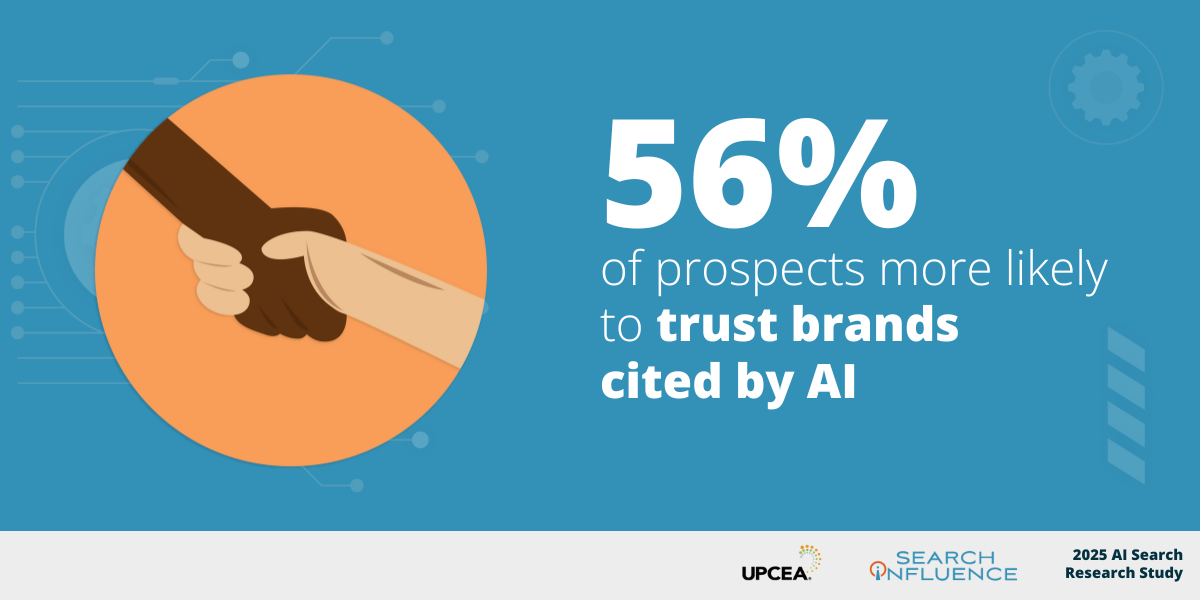
- 56% of students are more likely to trust a brand that is cited by AI.
Search engines and university websites remain core discovery channels
- 84% of prospects use traditional search engines to explore professional and continuing education programs.
- 63% of prospects rely on university websites during their research process.
- 77% of prospects trust university-owned websites over other sources.
- 82% of prospects are more likely to consider programs that appear on the first page of search results.
Search behavior is expanding across multiple platforms
- 84% of prospects use search engines to research professional education opportunities.
- 61% of prospects use YouTube.
- 50% of prospects use AI tools.
Social platforms still influence consideration
- Nearly 70% of prospects say frequent recommendations on social media increase their likelihood of considering a product or service.
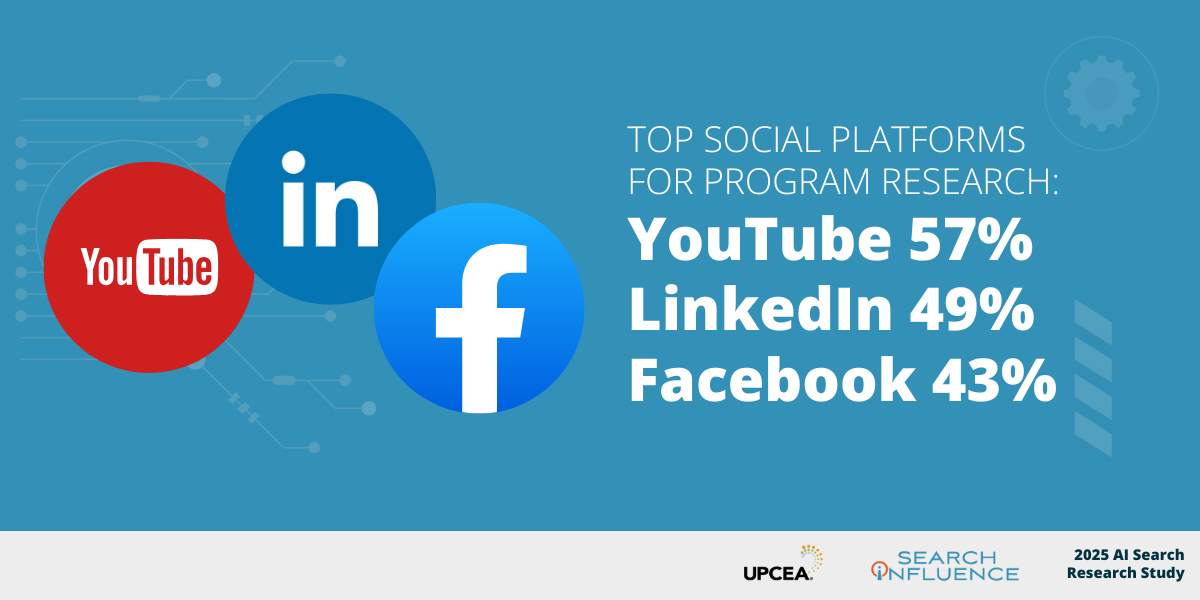
- YouTube (57%), LinkedIn (49%), and Facebook (43%) are the top social media platforms for program research.
How prospects search and what content they want
- Multi-word search phrases dominate how prospects search for programs.
- Prospects under age 35 show nearly twice the interest in professional and continuing education compared to older audiences.
- 65% of prospects want clear program summaries in social content.
- 54% of prospects look for career guidance and outcomes.
- 50% of prospects want testimonials and real student perspectives.
This data is drawn from AI Search in Higher Education: How Prospects Search in 2025, a research study conducted by Search Influence in partnership with UPCEA in March 2025. The study is based on survey responses from 760 prospective adult learners and examines where students search for programs, how they use AI tools and alternative platforms, and which sources they trust most during the decision-making process.
Institutional Readiness for AI Search in Higher Education
AI search strategy adoption across institutions
- 60% of institutions say they are in the early stages of exploring AI search.
- 30% of institutions report having a formal AI search strategy in place.
- 10% of institutions have not started or do not believe AI search will significantly impact student discovery.
Challenges slowing AI search adoption
- 70% of institutions cite limited bandwidth or competing priorities as their biggest barrier.
- 36.67% of institutions report a lack of in-house expertise or training.
- 26.67% of institutions cite unclear ROI, lack of leadership buy-in/institutional support, or uncertainty about how AI search works as slowing progress.
What institutions are prioritizing in AI search strategy
- 59.26% of institutions prioritize the accuracy of AI-generated information about their programs.
- 48.15% of institutions focus on improving visibility and competitive positioning in AI-driven results.
- 22.22% of institutions say other initiatives currently take priority.
- 14.81% of institutions are waiting to see how AI search evolves before acting.
Tracking and Measuring Visibility in AI-Generated Search Results
Awareness and monitoring of AI search visibility
- 56.7% of institutions know their institution appears in AI-generated answers.
- 26.7% of institutions have seen their institution referenced once or twice, but do not actively track it.
- 13.3% of institutions are unsure whether they appear in AI-generated responses.
- 64.29% of institutions that track AI visibility use dedicated tools or formal tracking methods.
- 28.57% of institutions do not formally track their AI visibility.
The above insights are based on the AI Search in Higher Education Snap Poll, conducted by UPCEA in October 2025. The poll surveyed 30 UPCEA member institutions to understand how colleges and universities are responding to AI-driven changes in student search behavior.
Frequently Asked Questions About AI Search in Higher Education
What is AI search, and how is it changing higher education discovery?
AI search describes how people use AI-powered tools and summaries to find and compare information across many sources at once. Rather than navigating page by page, users increasingly rely on AI to surface key context and options early. In higher education, this behavior is already widely adopted, with 50% of prospective students using AI tools at least weekly and 79% reading AI-generated overviews when they appear. As a result, early impressions of programs are often formed before a student reaches a university website.
Does AI search optimization replace traditional SEO for higher education marketing?
No, AI search optimizations do not replace traditional SEO strategies. Rather, they build on them. AI-powered tools still rely on well-organized, relevant, and authoritative content to generate accurate summaries and recommendations. For higher education, that means strong technical foundations, clear program pages, and credible signals remain essential. AI search adds a new layer of visibility, but it only works effectively when the underlying SEO structure is sound.
What risks do institutions face if they ignore AI search?
Ignoring AI search increases the risk of being invisible or misrepresented during early research. Because AI-generated summaries often guide program awareness, institutions that do not appear may never enter a prospect’s consideration set. Research shows that while 56.7% of institutions believe they appear in AI-generated answers, many do not actively track that visibility, creating blind spots that can quietly undermine recruitment efforts. Awareness without measurement leaves exposure gaps.
Can institutions influence what AI tools say about their programs?
Yes, organizations can influence AI outputs by improving the clarity and consistency of the information AI systems reference. AI tools commonly draw from authoritative, well-structured content when generating summaries. For higher education institutions, this means program pages, admissions information, and outcome-based content play a direct role in how programs are described. Influence comes from strong content foundations rather than direct control.
How should marketing teams prepare for continued changes in AI search?
Marketing teams should approach AI search as an extension of modern discovery, not a separate channel. Preparation includes understanding how information is summarized, ensuring content is accurate and extractable, and monitoring visibility across AI-driven environments. Higher education teams that align content strategy with student research behavior are better positioned to adapt as AI search continues to evolve. The goal is sustained visibility, not one-time optimization.
What This Means for Higher Education Marketing Teams
Student behavior has moved faster than institutional strategy, creating visibility gaps at the earliest stages of discovery.
AI-generated answers now play a meaningful role in which programs make it into a prospect’s consideration set, raising the stakes for how institutions appear in those environments. As this shift accelerates, accuracy, clarity, and consistency across owned content directly influence how programs are represented and trusted.
To explore the full state of AI search in higher education, download AI Search in Higher Education: How Prospects Search in 2025 today