The Maps Pack Is Dead — Here’s What Ate It (And How to Get Found Anyway)
April 8th, 2026 by
Key Insights
- AI Overviews are actively replacing traditional Maps packs for high-intent local searches, reducing visibility to a smaller set of trusted businesses.
- Local SEO has shifted from ranking pages to validating entities. Consistency, citations, and structured data now drive inclusion.
- Intent chips reveal the exact attributes Google prioritizes; they function as a real-time optimization blueprint.
- AI visibility is binary. If your business is not cited, it is effectively invisible in AI-driven search experiences.
- Schema, topic consolidation, and GBP optimization work together to make your business eligible for AI citation across multiple queries.
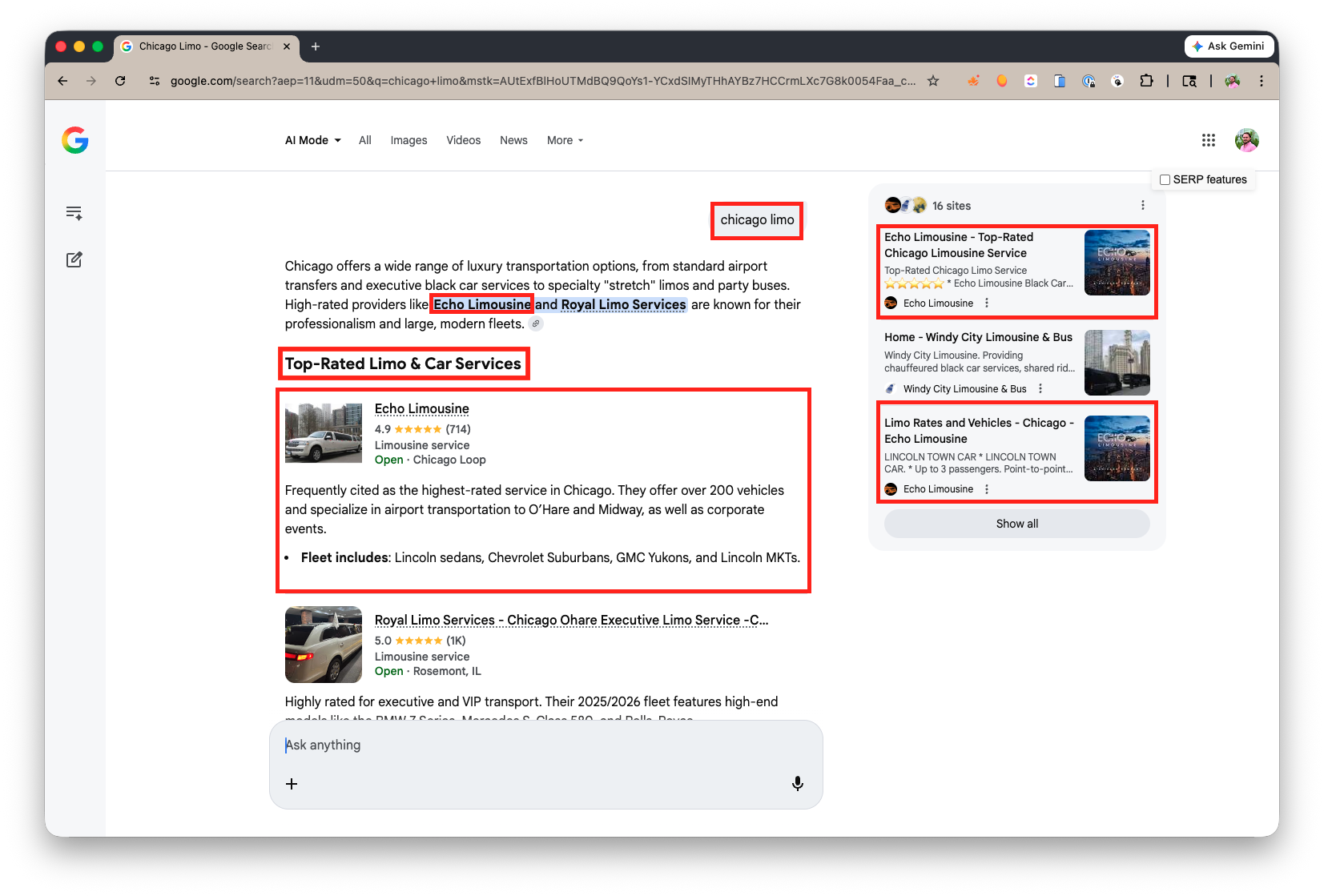
One afternoon earlier this month, we were live on a client call, screen share up, six incognito tabs open, running searches for Chicago limo terms. We expected the familiar 3-pack. Instead, we got an AI Overview labeled “Top-Rated Limo Companies in Chicago.” No map. No pins. Our client was cited five times. No traditional pack at all.
That moment crystallized something we’d been watching build for months. The Maps pack isn’t gone entirely. You’ll still see it for certain queries with clear local intent. But for competitive, high-intent searches, it’s increasingly being displaced by AI-generated entity packs that play by completely different rules. The businesses winning right now built for this before most people knew it was happening.
Here’s what changed, what’s driving it, and what to do about it.
The Pack Is on Life Support. Meet Its Replacement.
The Maps 3-pack was predictable: optimize your GBP, earn reviews, build citations, and get calls. Everyone knew the game.
Now Google is swapping those map-based results, especially for competitive queries, with AI-generated packs labeled “Top Rated” or “Key Service Providers.” According to BirdEye data via Near Media EP 248, GBP impressions are down 54% industry-wide, while conversions are holding steady. AI is compressing the funnel, filtering out low-intent browsers before they ever click. The people who reach you now are more likely to convert, but fewer businesses are making the cut.
That’s because these AI packs surface roughly 32% as many businesses as the traditional 3-pack. Going from three spots to one. And LLM visibility is binary: either you’re cited, or you don’t exist. There is no position 4.
The transition is happening query by query, category by category. The map pack doesn’t disappear all at once. It just shows up less, gets pushed down, or gets replaced by an entity pack that operates on signals most businesses haven’t started to optimize.
Intent Chips: The Secret Menu Google’s Been Showing You All Along
Here’s the angle almost no one is talking about.
Before AI Overviews, Google was already telling you exactly what it valued for every local category, hiding in plain sight as those clickable filter chips on local SERPs. “Open now.” “Highly rated.” “Free estimates.” “Accepts insurance.” “Same-day service.”
Most people treat them as UI decoration. They’re not. They’re Google’s cheat sheet — and yours.
The chips define the entity map for your category. Whatever attributes appear as chips for your niche are the attributes Google is actively weighing when it evaluates businesses in that space. If your GBP, schema, and content don’t speak to those attributes, you’re not playing the game AI is evaluating.
AI internalized the filtering. Users used to click chips to narrow results manually. Now, AI Overviews do that work automatically, deciding who gets cited for “24-hour leak repair near me” before a user ever sees the results. As LocalDominator notes, “If your GBP just says ‘Plumbing’ but your reviews don’t mention emergency service, you might get skipped in an AI result for ’24-hour leak repair near me.'”
If the SERP is a job interview, the intent chips are the job description. Search your own category right now. Those chips are your optimization checklist.

What the Smartest People in Local Search Are Saying
Darren Shaw of Whitespark published the 2026 Local Search Ranking Factors survey covering 187 factors, including a brand-new category, “AI Search visibility impact,” which alone added 47 new factors. AI visibility is now a primary competitive dimension, not a sidebar. Shaw is also tracking a content shift: less long-form fluff, more succinct, structured writing that LLMs can parse, layered with conversion copy for humans. And on the Local Marketing Secrets podcast, he’s clear that behavioral signals (dwell time, photo views, bounce-backs to search) are now critical. Existence isn’t enough. Engagement matters.
Our own Will Scott put the entity challenge precisely in Search Engine Land: “Today, LLMs can give you wrong information. Disambiguation through context is critical. So when they are building their ontologies — their map of relationships of knowledge — consistency matters a lot.” Our 2025 AI Search in Higher Education research found that 79% of respondents read AI Overviews and 50% use AI tools weekly. You’re now competing on two fronts, traditional rankings and AI citations, and most businesses are only playing one game.
On the macro level, BirdEye’s data shows AI Overviews appeared in 13.14% of queries in March 2025, up from 6.49% in January. Google’s AI Mode went live to all U.S. users in May 2025. The Near Media team is flagging that Google’s “Ask Maps” conversational interface represents a shift from keyword-based search to task-based local discovery, multi-constraint natural language queries handled inside Maps. The businesses that surface for those queries aren’t the ones with the most reviews. They’re the ones whose entity signals are clean enough for AI to confidently match.
The Entity Map Is the New Local Rankings Race
Traditional local SEO ranked pages. AI-era local SEO establishes trust in your entity — the AI’s representation of your business as a coherent, verified thing in the world. AI doesn’t sort pages anymore. It sorts businesses and surfaces only the ones it can confidently describe.
Local Falcon’s 2026 guide makes the stakes clear: three of the top five AI search visibility factors from Whitespark’s survey are citation-related — “best of” list inclusion, prominence on industry-relevant domains, and quality of unstructured citations. PinMeTo agrees: citations never stopped being a trust layer. AI just raised the stakes. A citation in the right place isn’t just a NAP signal. It’s a vote of confidence in your entity.
Think of it like an always-evolving Wikipedia page that Google is continuously rebuilding from every credible reference it can find about your business. AI systems look for consistency and consensus across those sources. When your entity is clearly and consistently represented across trusted touchpoints, it can confidently surface and cite your business across queries and search experiences. Thin, contradictory, or confusing — you don’t get recommended. Clear, consistent, authoritative — you get cited across multiple queries, multiple surfaces.
The Echo Limo Proof Point
During that client call in March 2026, we ran six incognito searches for Chicago limo terms. Echo Limousine didn’t just show up. It dominated. AI Overviews cited Echo five separate times for “Chicago Limo.” For “limo service Chicago,” Echo’s homepage appeared in the AI Overview and ranked #1 organic. “Car service Chicago” — same. When a local pack did appear, it wasn’t labeled as a Maps pack. It was labeled “Key Service Providers.”
What got them there:
- Comprehensive content structure and entity coverage — every service variation covered, topic authority established, related intent consolidated rather than scattered across multiple service pages
- Schema across all service pages — implemented in a single morning using SI Studio, our AI-powered workflow tool (what used to take ~10 hours)
- Topic consolidation — chauffeur service and car service content moved onto the homepage, aligned with exactly what Google’s AI serves for those query variations
Schema plus topic authority plus clean GBP signals equals AI citation across every major query variation. Echo wasn’t lucky. The work was done right and done before most of their competitors had heard the term “Key Service Providers.”
Your Action Plan: How to Show Up When AI Is the Gatekeeper
- Read your intent chips like a content brief. Every chip in your category represents a GBP attribute, a review signal, or a schema opportunity. If your business doesn’t own those attributes, you’re invisible to the AI doing the filtering.
- Treat your GBP as an AI data feed, not a listing. Your GBP data is structured input that Google’s AI synthesizes into responses for conversational searches and voice queries. AI is generating answers from that data, whether you’ve optimized it or not. Control the input.
- Consistency is your entity signal. Name, address, phone, services, categories, and descriptions should be identical across every platform. Every inconsistency is a disambiguation problem, and AI will skip an ambiguous entity. Audit and fix.
- Schema plus topic consolidation equals citation eligibility. FAQ schema, review schema, pricing transparency, consolidated service pages — this is what gets you cited. Don’t split authority across a dozen thin pages when one well-structured page does the job.
- Start tracking AI visibility, not just rankings. Traditional rank tracking doesn’t capture AI citations. Monitor your appearance across ChatGPT, Perplexity, Google AI Overviews, and Gemini for your core queries. As Kaare Wesnaes of Ogilvy North America told eMarketer: if you’re not cited, you effectively don’t exist.
Frequently Asked Questions
Is the Google Maps 3-pack going away completely?
No, the Google Maps 3-pack is not going away completely, but it is appearing less often for high-intent searches. Google is increasingly replacing it with AI-generated results like “Top-Rated” or “Key Service Providers,” especially for competitive queries. The 3-pack still shows for simpler or location-based searches, but it is no longer the primary way users discover local businesses.
What determines whether my business appears in AI Overviews?
AI Overviews include businesses that have strong, consistent, and trustworthy entity signals. This includes accurate business information across platforms, structured data like schema markup, authoritative citations, and optimized content that clearly matches user intent. Google’s AI prioritizes businesses it can confidently understand and recommend.
How do intent chips impact local SEO strategy?
Intent chips show the attributes Google uses to evaluate and filter local businesses. These filters, such as “open now” or “highly rated,” are applied automatically by AI when generating results. If your business does not clearly reflect those attributes in your GBP, reviews, and content, it is less likely to appear in AI-driven results.
The New Game Is Being Chosen, Not Clicked
It’s not about ranking #1 anymore. It’s about being the confident answer that AI trusts enough to cite without hesitation. AI is reshaping local search into a discovery layer where entity intelligence, data consistency, and strong on-SERP signals determine who becomes the default answer in a market.
The Maps pack is still around, but it’s no longer the main event. The new packs are run by AI, and AI doesn’t give participation trophies. Either it knows who you are, trusts what it knows, and has enough signal to recommend you, or it picks someone else.
Visibility in local search isn’t gone. It just moved. Now you know where to find it.
Get in Touch
If your business isn’t showing up in AI-driven results, it’s not just a visibility problem. It’s an entity problem. Search Influence helps brands build the structured authority and consistency that AI systems trust.
Let’s make sure your business is the one AI chooses. Reach out to our team to start building your AI search visibility strategy today.
Images:
Pexels