
How to Optimize Content for AI Search Engines
November 21st, 2025 by
Key Insights
- AI search content optimization means structuring your content so AI systems can easily interpret, retrieve, and cite it in AI-generated answers.
- Traditional SEO remains the foundation — clean site structure, structured data, and authority signals still drive AI visibility.
- Organizing key insights, FAQs, and comparison tables makes your content easier for AI search engines to understand and surface in AI Overviews.
- Writing in clear, natural language and updating regularly helps AI platforms recognize your content as accurate, relevant, and current.
Search Influence leads in AI search content optimization by helping brands structure content that both humans and AI systems can easily understand and retrieve.
Just as Frank Lloyd Wright believed buildings should grow naturally from their environment, AI-optimized content should grow naturally from meaning and structure. The future of search belongs to those who can design information that fits its landscape, where every heading, list, and table works like a carefully engineered beam.
At Search Influence, we’re the architects of AI search visibility, helping site owners and marketers craft pages that perform beautifully across AI-powered search engines.
This isn’t a theoretical guide. It’s the nuts and bolts of how to build AI-optimized content that earns citations, captures AI-generated answers, and stays visible in an evolving AI search landscape.
Why Optimizing for AI Search Matters
AI-powered search engines like Google’s AI Overviews, Perplexity, and ChatGPT don’t just rank pages; they summarize them. Instead of serving ten blue links, these AI engines generate conversational AI answers synthesized from multiple trusted sources.
That means search visibility no longer stops at position one. You need your brand’s content to be included inside the AI answer.
Click-through rates are declining as zero-click searches rise, and users are becoming increasingly satisfied with direct responses from AI platforms. If your valuable content isn’t structured for retrieval, AI systems may skip over it entirely.
Optimizing for AI search isn’t about replacing traditional SEO; it’s about building on it. Think of AI search optimization as a natural evolution: combining the best of search engine optimization, structured data, and modern AI tools to help both humans and algorithms recognize your authority.
At Search Influence, we help brands adapt their digital marketing strategies so they stay visible as AI models rewrite the rules of search behavior.
Traditional SEO Is Still the Foundation
Before you dive into AI search optimization, make sure your traditional SEO is rock-solid.
AI search engines still rely on the same crawl and ranking infrastructure as traditional search engines. If AI crawlers can’t read, index, or trust your site, no amount of clever structure will help.
Key traditional SEO best practices still matter:
- Clean architecture and crawlability: Ensure internal linking is logical, pages load quickly, and site maps are up to date.
- Mobile-first performance: Many AI search tools prioritize user experience metrics tied to page speed and responsiveness.
- E-E-A-T signals: Add clear bylines, About pages, and author or brand context. Even a simple byline builds trust for AI engines.
- Structured data: Implement schema markup for FAQs, products, or local business details. It helps search engines understand relationships between entities.
AI systems like Gemini and Perplexity still rely on traditional search engine crawlers to determine credible citations. Traditional SEO is the foundation, and AI SEO is the architecture built on top.
Creating Key Insights at the Top
The best-optimized pages start strong. Your top 200 words are prime real estate for both readers and AI search platforms.
AI models scan for concise, self-contained summaries near the top of a page to define its topic and relevance. These “vectors of meaning” determine whether your page gets cited in AI search results.
How to create effective key insights:
- Write a 3–5-bullet “Key Insights” section summarizing the core takeaways (see the top of this blog!)
- Use keyword-rich, natural language that mirrors user intent (think “how” and “why” phrasing.)
- Keep each insight standalone. If a model were to pull that one bullet out, it should still make sense.
- Include one light mention of expertise or authority (e.g., “Based on Search Influence’s experience optimizing higher-ed sites for AI visibility…”)
Pro Tip: Treat key insights like metadata in human language — short, factual, and extractable. AI systems interpret them as anchors for what your page means. More AI SEO pro tips here.
Building a Machine-Readable Table of Contents

Think of your table of contents as a blueprint that helps both humans and AI search engines navigate your page.
Just as a building’s floor plan shows how rooms connect, a well-structured TOC tells AI crawlers where each topic begins and ends. This improves comprehension, organization, and retrievability.
How to do it right:
- Use jump-linked headings (<a href=”#section-name”>) or your CMS’s automatic TOC generator.
- Reflect natural search queries in each heading — e.g., “How to Optimize for AI Search” rather than “Optimization Overview.”
- Keep heading hierarchy consistent (H2 → H3 → H4).
- Use descriptive, not vague language.
- Add ItemList schema markup around the TOC for extra machine clarity.
A good TOC tells AI engines how the story flows and helps your content appear in multiple passage-level citations within AI-generated responses.
Writing a Semantic Triple Intro
A semantic triple intro is a concise statement that defines your topic in the format of subject + predicate + object.
Example: “AI search content optimization is the process of structuring web content so it can be easily retrieved, summarized, and cited by AI-driven search engines.”
This tiny sentence packs a big SEO punch. It clearly tells AI systems what your page is about before anything else.
Why it matters:
- AI engines convert text into numerical “embeddings.” The first few sentences shape your page’s meaning signature.
- A strong semantic triple reduces ambiguity and helps your content rank for related natural language queries.
How to do it:
- Use your main keyword naturally.
- Define what it is and what it does.
- Follow with a quick credibility line (e.g., “At Search Influence, we help businesses earn visibility in AI-generated answers.”)
- Avoid filler like “In today’s world…” — it wastes your most valuable context window.
Chunk Content for AI Retrieval
Psst… You wanna know a secret? AI engines don’t read like people; they retrieve by passage.
Instead of analyzing an entire web page, AI systems break text into smaller “chunks” and compare them to user queries.
Best practices for chunking:
- Keep each section around 150–300 words.
- Focus on one topic per chunk.
- Start each with a clear claim or question, then support it with concise examples or bullet points.
- Use transition phrases like “For example” or “This means” to preserve context.
- End each chunk with a short takeaway sentence that restates the point (see below).
Chunking multiplies your retrieval opportunities. Each section can be surfaced as its own AI search answer.
Using FAQs to Capture Long-Tail AI Queries
If AI Overviews had a favorite format, it would be the FAQ.
Why? Because FAQs naturally mimic how people search in natural language. Each question represents a distinct user intent that AI tools can easily identify, summarize, and cite.
Why it matters:
- Long-tail questions like “How do AI search results work?” align perfectly with how users phrase queries in AI-driven search and voice search.
- Each Q&A acts as a self-contained data node, making your page more likely to appear in AI-generated responses.
- Structured FAQs feed into the Google Knowledge Graph, improving your search visibility across generative search engines.
How to implement:
- Use tools like AlsoAsked or Semrush to identify conversational long-tail questions centered around your topic.
- Phrase questions naturally. Avoid stiff or keyword-stuffed wording.
- Begin each answer with a semantic triple that defines the topic clearly.
- Support with concise bullets, data, or short examples.
- Add FAQPage schema markup so AI crawlers recognize the format.
Think of FAQs as the structural beams that make your content citation-ready. Each question builds another route to reach your audience.
Visuals, Tables, and Comparison Content
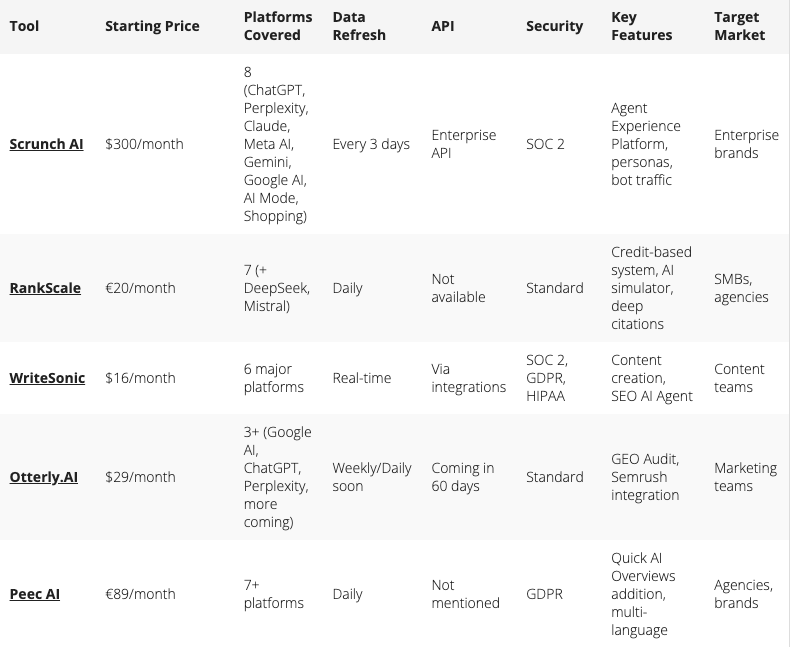
Text isn’t the only thing AI engines read. AI search platforms use tables, charts, and labeled visuals to understand relationships and compare information.
Why comparison content works:
- Tables make AI-generated answers more precise. They can extract facts directly instead of summarizing loosely.
- Comparison charts satisfy evaluative intent, a frequent category in AI search queries (e.g., “AI SEO vs. traditional SEO”).
- Data tables strengthen embeddings by clarifying relationships between key details.
How to structure tables for AI systems:
- Use real <table> tags or Markdown tables, never screenshots.
- Label columns descriptively: “Traditional SEO Tactics” | “AI SEO Tactics.”
- Keep it simple: 3–5 columns, 5–10 rows.
- Write factual captions, not marketing fluff (e.g., “This table compares how traditional and AI-driven search optimization differ in structure and retrieval focus.”).
- Include schema markup where relevant.
AI can quote directly from a well-structured table, boosting your authority in AI-powered search engines.
Writing for Humans and Machines
The best AI-optimized content reads smoothly to humans and structurally to machines.
Follow these hybrid writing rules:
- Use clear, factual sentences that stand alone if excerpted.
- Keep paragraphs under 120 words.
- Avoid vague language. Replace “this” or “it” with clear nouns.
- Add internal linking every 150–200 words to reinforce relationships between entities.
- Balance narrative and structure: storytelling for people, schema for crawlers.
Remember: clarity isn’t just stylistic, it’s structural. It helps AI understand what matters.
The Blueprint for AI Search Visibility
Let’s recap your new building plan for AI search optimization:
- Lay the foundation: solid SEO fundamentals first.
- Frame the entryway: start with a clear semantic triple.
- Add the blueprint: summarize early with key insights.
- Map the layout: create a TOC and structured content chunks.
- Finish the details: use FAQ schema, visuals, and comparison tables.
The goal? A digital structure that humans and AI engines recognize as sound.
Search Influence helps brands design these frameworks to thrive in a world of AI-driven search and generative engine optimization.
AI Content Optimization FAQs
1. How to optimize content for AI search?
AI search content optimization is the process of structuring digital content so AI systems can retrieve, summarize, and cite it accurately.
To optimize effectively, focus on clarity, organization, and accessibility. Start by breaking your page into self-contained sections with clear H2s and H3s, ensuring each chunk of content addresses a single topic. Use structured data and schema markup to help AI crawlers interpret meaning, and reinforce relationships through strong internal linking.
Keep your content current with up-to-date examples and sources. AI platforms prioritize pages that demonstrate freshness and accuracy. The more clearly your structure communicates what each section is about, the easier it is for AI search engines to select, summarize, and cite your work in AI-generated answers.
2. How to write content for AI search?
Writing for AI search means combining clarity, structure, and contextual depth that both humans and algorithms can understand.
This approach starts with writing in natural language that reflects how people actually search using long-tail, conversational keywords that match user intent. Begin your piece with a strong semantic triple and support it with concise, fact-based explanations.
Avoid vague language, dense jargon, or keyword stuffing, which can confuse both readers and AI engines. Instead, focus on writing self-contained paragraphs that answer one question or explain one concept at a time.
The goal is to make your content easy to read, easy to reference, and easy for AI systems to understand, all while delivering genuine value to your audience. These are insights marketers can’t afford to miss.
3. What is AI search?
AI search is an intelligent system that uses language models to interpret and synthesize web information.
Unlike traditional search engines that simply match keywords, AI-powered search engines like Gemini, GPT, and Perplexity analyze meaning, relationships, and intent behind queries.
These AI models draw from multiple authoritative sources, summarizing content to deliver direct, conversational answers. Instead of serving a list of blue links, AI search engines generate synthesized overviews, making accuracy and structure more important than ever.
Understanding how AI search works helps you build content that earns citations and remains visible across this new landscape of AI-generated results.
4. How do AI search results work?
AI search results are generated by analyzing and summarizing multiple high-authority sources into one synthesized response.
When a user enters a query, AI systems identify relevant passages, or “chunks,” from indexed web content. These passages are then combined, summarized, and rewritten in natural language to provide a complete answer.
Structured, fact-based content with schema markup and clear sectioning helps AI determine what information to include and who to cite. The result is a unified, conversational overview drawn from many sites, with attribution given to the most trustworthy and clearly organized sources.
This is why creating structured, authoritative content is key to being referenced within AI-generated answers.
5. Why is AI-optimized content important now?
AI-optimized content is crucial because generative search engines prioritize structured, factual information over traditional keyword density.
As tools like Google’s AI Overviews reshape how people access information, visibility now depends on whether your content is retrievable and citable by AI systems. Instead of focusing solely on ranking position, site owners must think about inclusion in AI-generated summaries, the new “position zero.”
Structured content supported by schema markup, internal linking, and fresh data is far more likely to be featured in these overviews. Investing in AI optimization now ensures your content stays relevant and continues to attract attention even as user behavior and search technology evolve.
6. How do I know if my content is AI-optimized?
AI-optimized content demonstrates clear structure, entity consistency, and schema integration that make it retrievable by AI systems.
To evaluate your current pages, look for clear topic separation, consistent use of entities (like names, products, or locations), and properly implemented structured data.
Each section should serve a specific purpose and read well both in context and isolation. Lists, FAQs, and tables should be properly labeled and formatted for easy parsing. You can test your content’s performance in AI platforms like Perplexity or use emerging AI SEO tracking tools that monitor how your content appears in AI Overviews.
If your web pages are easily understood, cited, or summarized by AI tools, you’re on the right track toward sustainable AI visibility.
7. How often should I update my content for AI optimization?
Regular updates signal freshness, an important trust metric for AI retrieval.
AI engines and traditional search algorithms value recency because it suggests reliability. Reviewing your content quarterly helps ensure that statistics, external links, and schema markup stay accurate and relevant.
Update examples, visuals, and tables as trends evolve, and consider adding new FAQs to reflect emerging search behavior. Regular optimization also gives you an opportunity to re-chunk long sections into smaller, more focused passages that align with current AI retrieval models.
In a rapidly changing AI-driven search environment, staying up to date is not optional; it’s the difference between being cited and being invisible.
Stay Ahead With Search Influence
AI search is shaping how every Google search result is generated and displayed.
Search Influence specializes in turning traditional SEO content into AI-optimized assets that perform across every AI search platform.
Here’s how we can help you build your next competitive edge:
- Audit your top pages for AI readiness, analyzing structured data, schema markup, and retrievability.
- Upgrade your content architecture for the AI era.
- Implement optimization strategies that strengthen traditional rankings and AI citations.
- Track performance to understand how AI engines reference your brand.
- Consult and educate your team on how to create comprehensive content that satisfies both search algorithms and users.
AI search is rewriting the rules of visibility, and the brands that adapt their structure now will own tomorrow’s results.
Let’s talk about how we can audit your site for AI readiness and start building your AI-optimized content framework today.