
The Future of Search: SEO and AI Impacts Explained
August 7th, 2026 by
Note: This post was updated by August 7th, 2026 by Cory Agular to reflect current best practices. It was originally published on March 21st, 2025.
Key Insights
- AI has fundamentally changed how people search, not just how results are displayed: AI Mode is now Google’s default global search experience, and agentic browsing tools from OpenAI, Anthropic, Microsoft, and Perplexity let users complete tasks without clicking through to a website at all.
- SEO remains foundational, but the target has shifted from ranking to citation: organic ranking still improves the odds of being referenced in AI-generated answers, though that relationship has loosened significantly since AI Overviews launched.
- Authority and credibility matter more than ever, and now come with formal mechanisms attached: Google’s Preferred Sources program and AI content licensing deals mean trust signals increasingly translate into visibility through partnership, not just algorithmic ranking.
- Optimizing for AI requires a broader strategy than optimizing for one platform: content needs to perform across AI Overviews, AI Mode, agentic search, and LLMs, each with different retrieval and citation behavior.
- Search Influence offers AI SEO and generative engine optimization services to help brands stay visible as search evolves: our approach combines traditional SEO fundamentals with citation tracking, entity optimization, and platform-specific strategies.
Generative AI has changed the way people search for information online. According to a 2026 survey by Clear Spark Digital, 97.6% of U.S. adults have used AI tools like ChatGPT, Gemini, or Copilot to find information, and 76% use them at least weekly.
AI search has moved well past AI Overviews. Google’s AI Mode became the default global search experience in 2026, rebuilding the search box around conversational queries, and agentic features can now complete multi-step tasks and follow up on their own, without a user ever clicking through to a website. For marketers, that’s a different challenge than “AI pushes rankings down.” Increasingly, AI doesn’t just summarize the answer. It can act on it.
Maintaining your relevance and traffic requires tactics built for AI search visibility, also known as generative engine optimization, alongside traditional SEO. Here’s what to know about SEO and AI impacts in 2026, and how to navigate them.
What Is AI Search?
AI search refers to search engines and digital platforms that use artificial intelligence to generate direct, summarized answers to user queries. Rather than simply ranking web pages, these tools analyze vast amounts of data, identify key insights, and deliver structured responses that align with the user’s intent.
AI search now spans several distinct experiences: AI Overviews, Google’s AI Mode, agentic browsing and search, and standalone AI platforms and LLMs. Each behaves differently, surfaces content differently, and carries its own implications for how marketers should measure and optimize for visibility.
AI Overviews
Google’s AI Overviews (AIOs), introduced in 2024, appear at the top of search results in response to queries. Rather than a passing feature, AIOs have matured into a core part of how Google surfaces answers: multiple 2026 industry trackers put AIO prevalence at roughly 25-48% of all Google queries, depending on methodology, with commercial-vertical prevalence rising sharply from the low single digits when AIOs first launched.
AIOs also list citations alongside summaries, allowing users to explore original sources for more in-depth information. That raises the bar on what earns a citation: pages that repeat the consensus get skipped, while the ones AI quotes add something new, a measure called information gain. In practice, this means the SEO question has shifted from “does this page rank” to “does this page say something the AI hasn’t already synthesized from five other sources.”
AI Overviews’ impact on SEO
Declining search visibility. Because AIOs appear at the top of search results, they push traditional organic listings further down the page, sometimes below the fold entirely.
The rise of zero-click searches. Zero-click search, where users get their answer without clicking any result, has climbed steadily for years, and multiple 2026 studies now put the overall rate somewhere between 58% and 65% of all Google searches, rising further, sometimes above 80%, specifically on queries where an AI Overview appears.
Query type still matters, a lot. Despite wide variance across studies, the consistent pattern is that informational queries trigger AIOs far more often than commercial or transactional ones, sometimes by a factor of 5-7x. If your content strategy leans heavily on top-of-funnel informational content, expect steeper click declines there, even as it remains your best opportunity to earn a citation.
AIOs and click-through rates (CTRs). The picture is genuinely mixed: several major 2026 studies put the CTR decline for a page ranking #1 organically at roughly 34-61% when an AI Overview appears above it. What’s consistent: brands actually cited inside the AI Overview tend to retain meaningfully more clicks. Some studies put this at roughly 35% more than brands that rank organically but aren’t cited in the summary.
AI Mode
Google’s AI Mode became the default global search experience as of May 19, 2026, marking what Google has called the biggest change to Search in more than 25 years. Rather than a separate feature sitting alongside traditional results, AI Mode rebuilt the search box around conversational queries: users can ask complex, multi-part questions, get a synthesized answer, and then ask follow-up questions without starting a new search each time.
AI Mode’s impact on SEO
Personalization breaks the idea of a single “rank.” AI Mode results can vary from person to person based on search history, location, and prior interactions with Google. Brands should stop treating any single keyword ranking as the finish line and instead diversify how they earn visibility across owned content, citations, and reputation signals.
Preferred Sources is the new visibility lever. Google’s Preferred Sources program lets users select outlets and brands they want prioritized in their results. The program grew from roughly 90,000 sources at launch to more than 345,000 by mid-2026, and Google reports users are roughly twice as likely to click through to a Preferred Source when it appears. That’s partly a function of audience loyalty, not just algorithmic ranking, meaning newsletter signups and repeat visits now carry a direct AI-visibility payoff.
Conversational queries reward depth over keyword matching. Multiple 2026 trigger-rate studies confirm that longer, more conversational queries (7-8+ words, question-format) are substantially more likely, in some datasets 5-7x more likely, to surface an AI-generated answer than short, one- or two-word queries.
Licensing deals are reshaping visibility, too. Google is negotiating AI content licensing deals with roughly 20 national news publishers, a shift from its earlier free-indexing approach, driven in part by new regulatory pressure requiring publishers to implement opt-out controls. Google already has existing agreements, including a real-time news partnership with the Associated Press and a multi-year deal with Reddit. Combined with Preferred Sources, this signals that AI visibility within Google’s ecosystem is increasingly shaped by formal partnerships and editorial trust, not just crawling and ranking, a dynamic that brands without licensing leverage will need to compete with through citation quality and Preferred Source adoption.
Agentic Search and Browsing
Agentic AI has moved well beyond Google. Across the industry, companies are racing to make browsers and search tools capable of completing tasks, not just answering questions. OpenAI’s Atlas browser and Agent Mode, Anthropic’s Claude in Chrome and Claude Cowork desktop control, Perplexity’s Comet (now free across iOS, Android, macOS, and Windows), and Microsoft’s Copilot Mode in Edge all launched or expanded significantly in 2026. Google’s own push includes both agentic features in AI Mode and a Gemini integration across Chrome itself, unveiled at I/O 2026. The shared thread across all of these: they can navigate multi-step tasks like booking travel, filling out forms, or monitoring a topic over time, without a user manually clicking through each step.
Agentic Search’s impact on SEO
It breaks click-based measurement at the root, across every platform, not just Google. Whether the agent is Claude, Atlas, Comet, or Google’s AI Mode, the same problem applies: an agent completing a task or answering a follow-up on a user’s behalf can pull from your content and influence a decision, without generating a session, a click, or a UTM parameter your analytics can capture.
Value shifts from traffic to citation and trust, regardless of which agent is doing the browsing. As more of the search and browsing experience happens without a click at all, citation frequency and brand mention tracking become a more reliable proxy for whether your content strategy is working.
It changes what “conversion” looks like. With agentic checkout and multi-step task completion rolling out across several platforms, not just Google’s ecosystem, a user’s entire research-to-purchase journey can increasingly happen without a single referral visit to a brand’s website.
AI Search Engines and LLMs
AI-powered search engines and large language models (LLMs) offer a conversational way to search for and explore information. Unlike traditional search engines, which present ranked lists of web pages, these platforms generate detailed answers and let users refine queries through follow-up interactions rather than reformulating a new search each time.
These platforms also vary meaningfully in which sources they lean on most: one 2026 analysis found ChatGPT cites Wikipedia as a top source roughly 48% of the time, while Perplexity leans on Reddit at a similar rate, whereas Google’s AI Overviews draw from a notably wider range of sources than either. The platforms below are the most widely used, but the field is expanding quickly.
- Gemini powers Google’s own AI Mode and AI Overviews directly, and is also available as a standalone assistant, giving it the widest built-in distribution of any platform on this list
- Copilot offers a mix of live retrieval and indexed content, blending real-time web results with Microsoft’s own indexed data
- Perplexity emphasizes real-time, cited sources for transparency, and its Comet browser now runs on Claude by default for agentic tasks
- ChatGPT pulls from both retrieved and summarized content, with web search enabled by default rather than an optional add-on
- Claude functions both as a standalone research and chat tool and as the underlying model powering agentic browsing elsewhere, including Comet, making its citation behavior relevant even to brands not directly being asked about by a Claude user
- Grok is increasingly embedded directly into X (formerly Twitter), giving it a distinct real-time social data source that other platforms don’t have
- Meta AI is built into Facebook, Instagram, and WhatsApp, putting it in front of a massive built-in audience without users needing to seek out a separate app
AI search engine/LLM impact on SEO
Growing search traffic through AI-powered platforms. ChatGPT’s weekly active users climbed from 400 million in early 2025 to 900 million by February 2026, and OpenAI says it’s on pace to cross 1 billion weekly active users before the end of 2026. As more users turn to these platforms instead of, or alongside, traditional search engines, ensuring your content is referenced in AI-generated responses helps increase visibility and establish authority.
AI platforms and brand recognition. Some platforms, like Perplexity, consistently provide citations in their responses, while others vary in how they attribute sources depending on the query and subscription tier.
The connection between traditional SEO and AI visibility. Ranking well in organic search has traditionally impacted the likelihood of being referenced in AI-generated responses, though that relationship is loosening: one 2026 analysis found that while roughly three-quarters of AIO citations came from top-10 organic pages in mid-2024, that overlap had fallen to somewhere between 17-38% by February 2026. Ranking well organically is necessary but no longer sufficient on its own to guarantee an AI citation.
While SEO helps content rank, ensuring it is clear, credible, and easily retrievable increases its chances of appearing in AI-generated results across every one of these surfaces.
What Is Generative Engine Optimization?
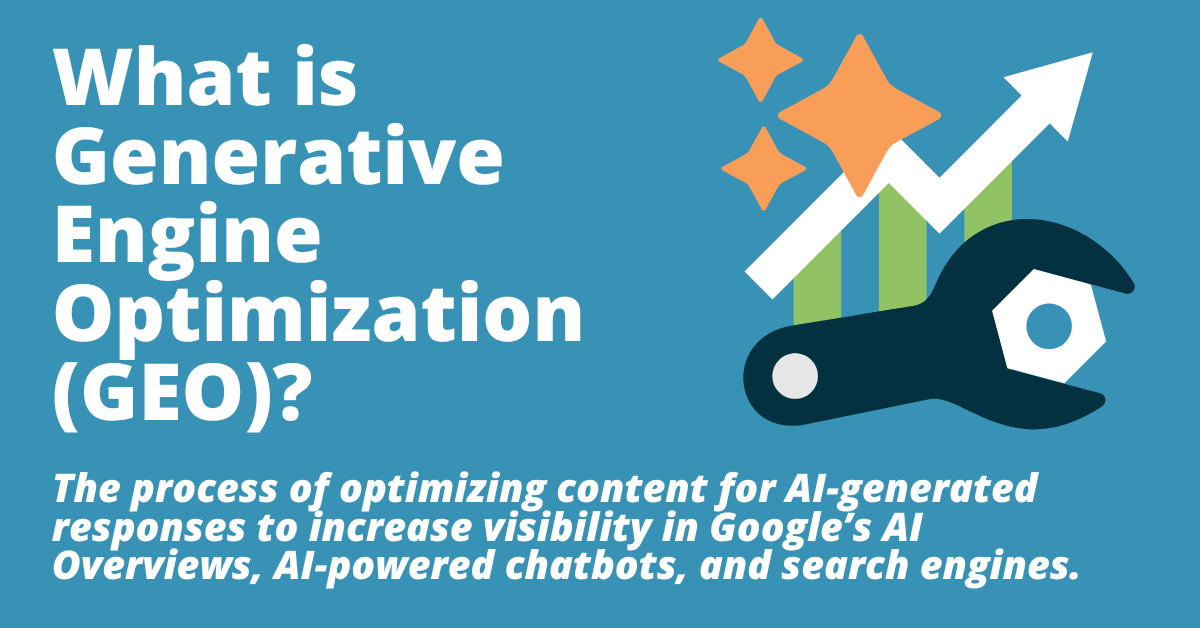
Generative engine optimization (GEO), also known as “AI SEO” or “answer engine optimization (AEO),” is the process of optimizing content for AI-generated responses, increasing visibility in LLMs and other AI-powered search experiences. While traditional SEO focuses on ranking web pages, GEO tailors content for AI models that extract and present direct answers.
By aligning content with how AI processes and prioritizes information, GEO helps marketers maintain authority, improve engagement, and capture opportunities across evolving search platforms.
How to Get Featured as an AI Source
A successful GEO strategy means getting included as an AI source, whether that’s in an AIO or a Perplexity response. Use these tactics to strengthen your AI visibility:
Improve your E-E-A-T
Google is more heavily emphasizing brand authority when ranking content and generating AIOs. Instead of solely optimizing for rankings, brands need to focus on strengthening Expertise, Experience, Authority, and Trustworthiness (E-E-A-T) to improve visibility.
AI models prefer sources that demonstrate credibility, which means establishing strong brand authority is essential. To improve E-E-A-T:
- Demonstrate expertise and experience: Highlight author credentials, industry insights, and first-hand knowledge.
- Maintain accurate business and directory listings: Ensure consistency across platforms like Google Business Profile and industry directories.
- Ensure content transparency: Properly cite sources and reference factual, verifiable data.
Focus on relevant, high-quality content
AI favors concise and informative content, meaning readability and structure are just as important as accuracy. Google’s passage ranking feature allows AI models to pull specific sections of your content to answer queries directly, so structuring information in a clear, digestible way improves its chances of being referenced.
To make your content more AI-friendly:
- Anticipate user intent and provide concise and informative responses that align with what users are searching for. AI-driven search prioritizes content that directly answers queries with detailed, structured, and context-rich information.
- Write in conversational language, using a natural, direct writing style and concise phrasing. AI models rely on natural language processing (NLP) to interpret and generate human-like text, making them more effective at understanding content that mirrors everyday speech. Overly complex or formal wording can create friction in processing, while clear, natural phrasing ensures better readability.
- Break down complex information into digestible, skimmable formats, such as bullet points or numbered lists, with clear subheadings.
- Include FAQ sections, as a structured Q&A format can help AI identify relevant insights quickly.
- Leverage multimedia content with schema markup, since AI increasingly references videos and images in responses.
Read more on how to optimize for AI search.
Leverage long-tail keywords
AI-generated search results are more likely to pull from content that matches specific, detailed queries. Long-tail keywords (phrases that are longer and more precise than broad search terms) help target the kinds of questions AI models reference in responses.
Search intent still plays a crucial role when optimizing for long-tail keywords, though the gap between query types has narrowed. Recent 2026 tracking studies put informational-query AIO trigger rates in the 36-91% range depending on methodology, while commercial and transactional queries now trigger AIOs anywhere from roughly 8-22% of the time, up sharply from the low single digits when AIOs first launched. The exact numbers vary by study, but the direction is consistent: commercial intent is no longer nearly as insulated from AI Overviews as it once was.
To best capitalize on long-tail keyword opportunities:
- Review “People Also Ask” (PAA) questions to identify commonly searched queries that AI models may prioritize.
- Analyze AI search engines like Perplexity to see what types of queries generate responses.
- Optimize for natural, conversational queries that reflect how users phrase searches in LLMs and voice search.
Optimize content for entities
AI models process content using entities (specific people, places, organizations, and concepts) rather than just keywords. While keywords are the words or phrases users type into search engines, entities act as nodes in a knowledge graph, helping AI understand relationships between concepts and generate more relevant responses.
To improve AI-driven visibility, structure your content to clearly define and connect entities:
- Use Schema.org structured data: Define entities such as businesses, products, authors, and services to help AI recognize key concepts.
- Link to authoritative sources: Reference Wikipedia, industry databases, and government sites to align with established entities AI understands.
- Leverage co-occurrence: When two or more words, phrases, or entities frequently appear together in content, AI models, especially LLMs like ChatGPT without search, become more likely to generate them. Strategic co-occurrence helps reinforce associations between key concepts.
- Utilize co-citation: When two entities (brands, websites, or sources) are cited or linked from the same source, it strengthens their perceived relationship in AI models, even if they aren’t directly connected.
- Structure content with semantic triples: AI processes information in subject-predicate-object statements (e.g., “Apple manufactures the MacBook Pro”), so clearly defining these relationships enhances AI comprehension.
- Enhance entity salience: Ensure that the most important concepts stand out within your content. Salience determines how relevant an entity appears in AI-driven searches and conversations. Think of it as a more structured way to signal significance without relying on keyword stuffing.
Prioritize your technical SEO
Strong technical SEO helps AI models better interpret, index, and surface your content. Without a solid technical foundation, even well-written and authoritative content may struggle to appear in AIOs or AI-driven search results.
To improve your technical SEO:
- Use schema markup to structure data: Properly coded structured data helps AI search engines understand key business details, such as operating hours, services, and locations, increasing the chances of being included in AIOs.
- Optimize title tags and meta descriptions: Clear, well-crafted metadata improves indexing and can enhance how AI models retrieve your content.
- Improve site navigation and internal linking: AI favors well-structured sites where information is easily accessible and logically organized.
- Ensure fast page speed and mobile usability: A slow, poorly optimized website signals low trustworthiness to search engines, reducing the chances of being referenced.
- Consider adding an llms.txt file: This emerging file gives AI crawlers a structured summary of your site’s key content. Adoption is still modest, running roughly 8-15% among top sites as of mid-2026, and a large-scale study of roughly 300,000 domains found no statistically significant correlation between having an llms.txt file and getting cited more often by AI. In fact, removing it as a variable improved the researchers’ predictive model. It’s worth adding for low-cost optionality since it costs little to implement, but don’t treat it as a proven citation booster or prioritize it over the content and technical fundamentals above.
Monitor your standing in AI search
As AI-powered search evolves, tracking your visibility in AI-generated results is just as important as traditional SEO monitoring. New and existing tools now offer AI search-tracking features, helping you understand how your content appears in AIOs and other AI-driven search results.
To stay ahead, leverage these AI search tools to track your rankings, analyze competitor performance, and identify opportunities for optimization:
- Purpose-built AI visibility platforms: Scrunch AI, RankScale, WriteSonic GEO, Otterly AI, Peec AI, xFunnel, Profound, RankZero, Rank Prompt, Rankshift, LLM Scout
- Traditional SEO platforms adding AI tracking: Semrush AI Toolkit, Advanced Web Ranking, SE Ranking, Ahrefs
For a full breakdown of pricing, platform coverage, and which tool fits which use case, see our AI SEO tracking tools comparison, put together by Will Scott, AI SEO expert.
At Search Influence, we also offer our own AI Visibility Tracker, powered by Scrunch, which shows how AI platforms are talking about your brand, covering citations, framing, sentiment, competitive benchmarking, and content gaps. Get in touch to try it out.
Does Bing Matter in AI SEO?
While Google dominates search, Bing still holds a significant share of queries, particularly in the U.S. Bing powers roughly a quarter of U.S. desktop searches when factoring in Yahoo and Microsoft’s search partners, making it an important platform to consider, and its relevance has only grown since Microsoft’s Copilot became a mainstream AI platform in its own right.
That last point matters more than it might seem. As covered earlier in this post, Copilot’s responses are grounded in Bing’s index rather than a separate retrieval system, meaning Bing SEO and Copilot visibility aren’t really two separate disciplines anymore. Optimizing for Bing is now partly optimizing for Copilot too.
Here’s how to pay attention to Bing in your AI SEO efforts:
- Submit your site to Bing Webmaster Tools (BWT) to ensure proper indexing and visibility.
- Monitor Bing rankings: While brands ranking on page 1 of Google strongly correlate (~0.65) with AI mentions, Bing rankings also play a role (~0.5–0.6).
- Stay updated on Bing’s algorithm changes: SEO best practices currently align with Google, but keeping an eye on potential Bing-specific shifts ensures continued optimization, especially as Copilot’s own retrieval behavior evolves alongside Bing’s core algorithm.
SEO and AI Impacts: Is SEO Still Important?
Short answer: yes, but it’s changing what SEO needs to accomplish. Traditional SEO remains the foundation of search visibility, even as the link between ranking and AI citation loosens.
Ranking well still improves your odds of being referenced in AI-generated responses, though less reliably than before: one 2026 analysis found AIO citation overlap with top-10 organic results fell from roughly three-quarters in mid-2024 to 17-38% by February 2026. Ranking well is now necessary, but no longer sufficient, for AI visibility.
That’s partly because AIOs still concentrate on a narrower slice of search demand than people assume. A widely cited 2024 Ahrefs study of 300K keywords found that the highest-volume AIO keywords averaged just 150 searches per month, compared to 29,000 for non-AIO keywords. However, this data predates AIOs’ significant expansion into commercial queries, so a fresher volume comparison would likely show a smaller gap today. Even with that caveat, organic search remains the dominant traffic driver, and marketers prioritizing SEO are still best positioned to capture high-intent demand.
Traditional SEO vs. AI SEO
| Traditional SEO | AI SEO | |
| Primary ranking signal | Backlinks, keyword matching, domain authority | Entities, citations, information gain, Preferred Source status |
| Success metric | Organic rankings, traffic, click-through rate | Citation rate, share of AI answers, brand mentions |
| Content format | Keyword-optimized pages targeting specific search terms | Structured, conversational content that anticipates follow-up questions |
| Discovery mechanism | Crawling and indexing | Crawling, indexing, plus formal licensing and data-partnership access |
| Primary interface | Ranked list of blue links | Conversational, AI-generated answers |
| Measurement model | Session and click tracking | Citation frequency and brand mention tracking |
Future of SEO FAQs
How is AI changing search?
AI is changing search in a few concrete ways: it’s shifting the primary interface from ranked lists of links to conversational, synthesized answers (AI Mode and AI Overviews), reducing the need for users to click through at all (zero-click search), and increasingly allowing tasks to be completed automatically through agentic search, with no click or session at all. For marketers, that means success is measured by citation frequency, brand mentions, and whether your content is trusted enough for an AI system to reference or act on.
What is the future of SEO?
The future of SEO is less about ranking a page and more about earning a citation. As AI Mode, AI Overviews, and agentic search handle more of the research and decision-making process directly, success increasingly means being the source an AI trusts enough to reference or act on, not just the page a user clicks. That rests on AI SEO fundamentals like clear structure, credible expertise, and technical accessibility, with the target shifting from rankings to visibility across a much wider set of AI-driven surfaces.
Will AI replace SEO?
No. Traditional SEO remains foundational, since ranking well in organic search still meaningfully improves the odds of being cited in AI-generated answers, even as that relationship loosens over time. What’s changing is the scope of the job: SEO now needs to account for AI Overviews, AI Mode, agentic search, and LLMs like ChatGPT and Claude, not just traditional search rankings. AI isn’t replacing SEO so much as expanding what it has to cover.
Stay Ahead in the Age of AI With Search Influence
AI search is evolving every day, reshaping how users find and engage with content. To stay visible, you need a nimble, data-driven approach that keeps up with both traditional SEO and AI-powered search trends.
That’s where partnering with an experienced agency can make all the difference.
At Search Influence, we continuously track organic traffic, click-through rates, and AI search KPIs to help our clients adjust their strategies and maximize their visibility in an AI-driven world.
Learn more about Search Influence’s AI SEO services.
SEO Roadmap for Higher Ed
For higher education marketers, our SEO Roadmap is designed to ensure your program pages remain competitive, even as AI-driven search changes the way students explore their options.
This customized, three-month strategy provides clear, actionable recommendations you can implement right away. It helps you improve rankings, strengthen visibility, and optimize for AIOs and AI-powered platforms. We factor in AI’s impact from the start, ensuring your content is structured for both organic search and AI-driven discovery.
Whether you’re refining an existing SEO strategy or building one from the ground up, Search Influence helps you stay ahead of AI search shifts so your brand remains visible where it matters most.
Let’s build a strategy that works for the future of search.